AI in Accounting: The Complete 2026 Guide
What AI does in accounting today, what AICPA, IESBA, ICAEW and the PCAOB have actually published, and how to adopt it without risking a client or a license.
AI in accounting has moved from conference talk to a feature inside software many firms already use. In a field study from Stanford and MIT, accountants who use AI finalized their monthly statements 7.5 days faster. That speed comes with duties attached: client confidentiality, review controls and professional responsibility that no vendor takes off your plate. This guide covers what AI does in accounting today and what the standard setters have actually published. It also shows how to adopt AI without putting a client or a license at risk.

This guide is general information, not legal, tax or professional advice. Check the rules that apply to you and your firm before acting on any of it.
What Is AI in Accounting?
The label covers very different tools, so sort them first. Some of what vendors call AI is an old-fashioned rule: if the payee is a fuel station, code it to vehicle costs. Some is machine learning, which spots patterns in your past entries. Some is a language model that writes and summarizes, and the newest layer, agentic AI, strings several steps together and acts inside limits you set.
| Type | How it works | Example task |
|---|---|---|
| Rules-based automation / RPA | Fixed if-then logic, no learning | A bank rule that codes a recurring software subscription |
| Machine learning | Learns patterns from past data | Suggesting a ledger category, or flagging an unusual invoice |
| Generative AI | Produces text and summaries from prompts | Drafting variance commentary or summarizing a lease |
| Agentic AI | Runs several steps with tools, under supervision | Chasing missing documents and preparing a draft reconciliation for review |
COSO’s 2026 guidance on generative AI offers a handy lens. As Journal of Accountancy reported, it sorts what AI does inside finance work into eight capability types. They are ingestion, transformation, posting, orchestration, judgment, monitoring, regulatory intelligence and human-AI interaction. Hold any tool you’re considering up against that list. Which of those jobs will it do for you, and who checks each one?
How Accountants Use AI Today
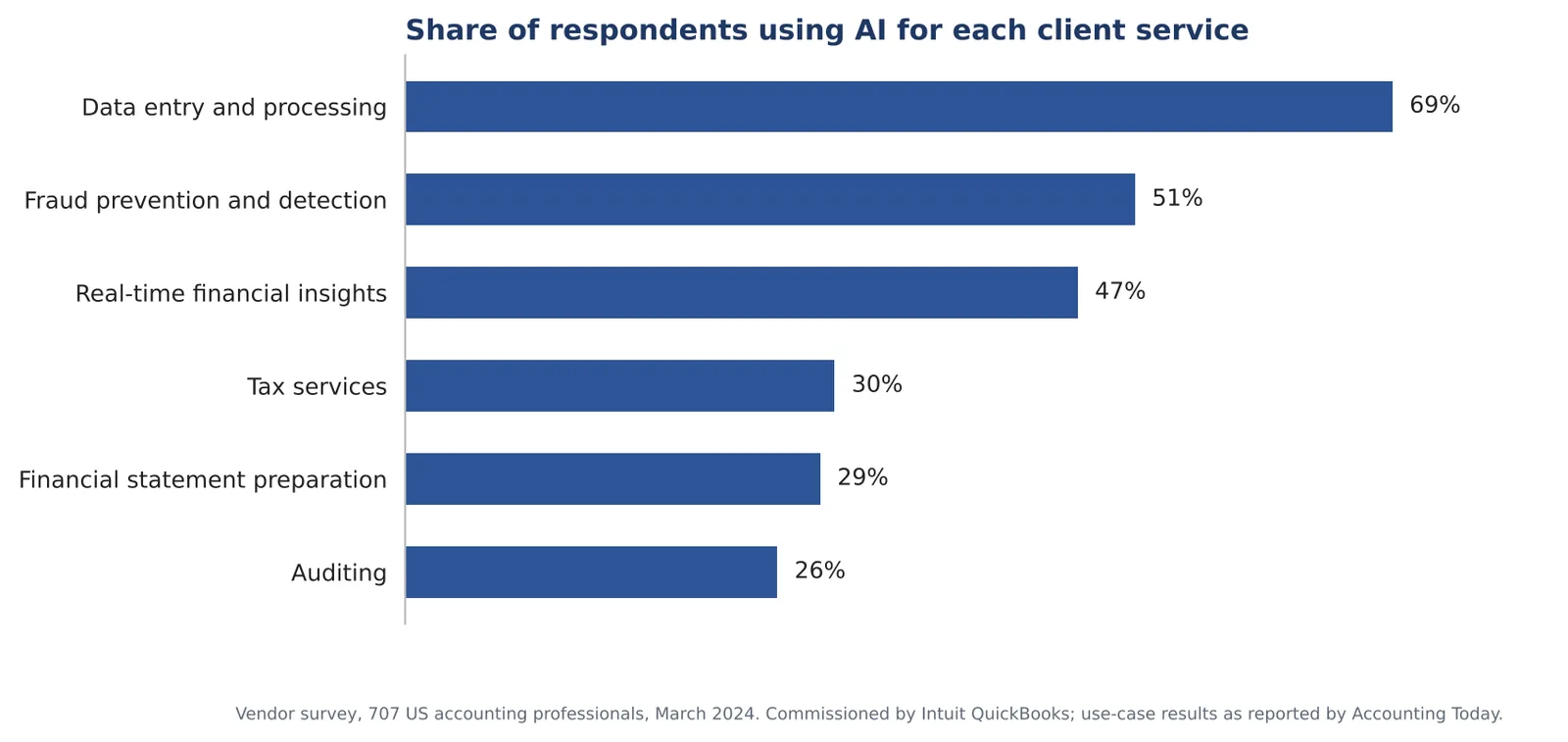
Most AI work in accounting is repetitive work. In a 2024 survey commissioned by Intuit QuickBooks, 707 US accounting professionals described how they use AI. Accounting Today reported data entry and processing at 69%, fraud prevention and detection at 51%, and real-time insights at 47%.
Tax services came in at 30%, financial statement preparation at 29% and auditing at 26%. Notice how the numbers shrink as the work leans harder on judgment. Read it as a 2024 vendor survey, a snapshot rather than a census.
Bookkeeping and transaction categorization
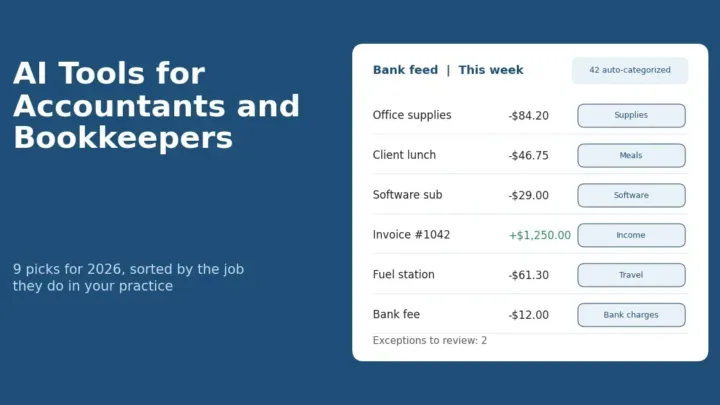
Bank feeds arrive, the software proposes a category and a match, and anything it can’t place drops into a review queue. A bookkeeper with dozens of clients stops retyping coffee receipts and starts clearing exceptions. In a typical setup nothing posts until a person approves it, so the books are only as good as whoever works that queue. For what’s on the market, see our guide to the best AI tools for accountants.
Document capture and accounts payable
Forward a bill to an inbox and the system reads the vendor, the amount and the dates, suggests coding, then routes it to an approver. Under the hood that’s text recognition, a classifier and an approval workflow. The usual failures are a misread amount or a duplicate invoice, which is why the approver still opens the source document.
Reconciliations and the month-end close
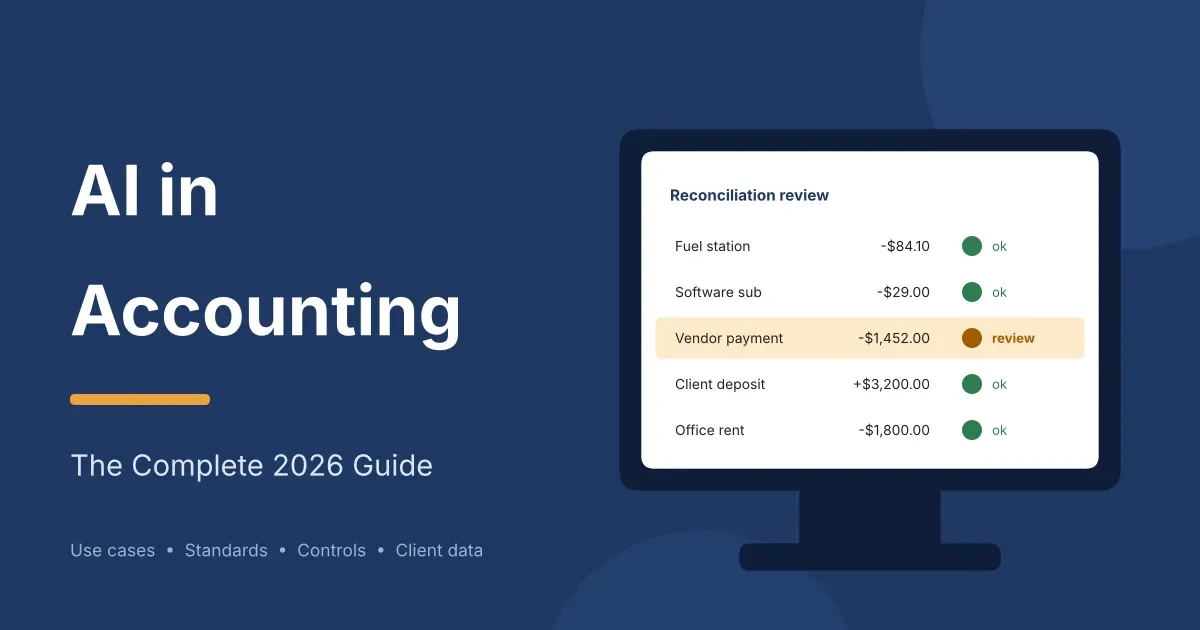
Matching bank lines to the ledger is slow pattern work. AI can pair the obvious ones, flag mismatches and draft a first explanation for a variance. That’s where the faster close in the Stanford and MIT study most likely comes from.
Picture a controller with 600 bank lines to clear. The tool pairs 540 on its own and parks 60 with notes, like a payment that cleared $48 short of the invoice. She spends the morning on those 60 instead of all 600.
Tax research and compliance
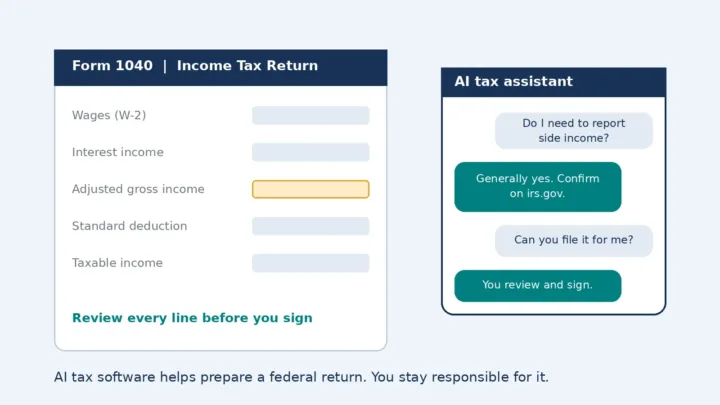
Citation-backed research assistants can surface code sections, rulings and cases faster than a keyword search. They can also invent authority that doesn’t exist, so every citation gets opened and read before it lands in a memo. If a client’s return data goes into the prompt, IRC Section 7216 comes into play, which we cover below. For options, see our page on AI tax software.
Audit and assurance
Auditors of public companies are cautious. A PCAOB staff spotlight from July 22, 2024 found generative AI use in audits was limited. It focused mostly on “administrative and research activities.” Tools that scan whole populations of transactions are growing, but they aren’t routine yet. We go deeper in how AI is changing auditing.
Reporting, FP&A and advisory
Once the ledger is clean, AI can draft management commentary, build a first-pass forecast or explain why gross margin moved. The Stanford and MIT study found firms using generative AI produced reporting that was 12% more granular. Time shifts from compiling numbers to interpreting them.
What the Research Says About AI’s Impact on Accounting Work
The best field evidence so far comes from Jung Ho Choi of Stanford GSB and Chloe Xie of MIT Sloan. Their paper, “Human + AI in Accounting: Early Evidence from the Field,” was summarized by Stanford GSB Insights in June 2025. They surveyed 277 accountants and gathered task data from 79 small and mid-sized firms that use AI-powered accounting tools. Accountants who use AI closed the books 7.5 days faster and spent 8.5% less time on routine back-office processing.

The same accountants were uneasy, though. Some 62% worried about AI errors, 43% about data security and 37% about job stability.
Keep this in proportion. It’s one early study of firms that had already adopted AI tools, and it says little about what happens in year three. What it does suggest is that AI is, for now, making accountants faster more than it’s making them redundant.
Benefits of AI in Accounting
Strip away the vendor hype and the benefits that hold up are practical.
- A faster close. The Stanford and MIT study linked AI use to finishing monthly statements sooner.
- More capacity. Less routine processing left room for richer reporting.
- Consistency. Software applies the same coding rule on the 400th invoice as on the first.
- Earlier error detection. Anomaly flagging can surface a duplicate payment or an odd journal in days instead of at year-end.
Picture a small practice that burns the last three days of every month chasing miscoded transactions. Once software handles the easy categories, those days go to explaining the numbers to clients. That only works if the review step stays in place.
Risks and Limitations Accountants Must Manage
The IESBA’s July 2026 staff publication on emerging technologies describes technology through seven characteristics: opacity, non-determinism, dependence on data, perpetual adaptivity, autonomy, scalability and speed. In plain terms, you often can’t see why a model said what it said. The same prompt can return different answers, bad inputs produce bad outputs, and a mistake can spread fast. Add automation bias, the habit of trusting an answer because it sounds confident.
None of that shifts the burden. The IESBA is clear that professional accountants remain responsible for the judgments and decisions made in their work.
Here’s how a review control earns its keep. An AI assistant drafts a journal entry for a $12,000 annual insurance premium and books all of it to insurance expense, with a memo that reads perfectly. The reviewer checks the policy and sees it covers twelve months. She moves the amount to prepaid expenses and releases $1,000 a month, which saves that month from being overstated by $11,000.
What AICPA, IESBA, ICAEW and the PCAOB Say About AI
What exists today is guidance, staff publications and updated ethics provisions, not a standalone AI standard. None of these bodies bans AI. Read together, they say the same thing: use it if it helps, stay competent, protect confidentiality and own the result.
AICPA & CIMA (US)
The AICPA & CIMA released a Small Firm Generative AI Policy Template on April 29, 2026. It’s available to members only, and it’s aimed at firms setting rules for ethical use of publicly available large language models. That makes it a sensible starting point for the policy step later in this guide.
The binding rules sit in the AICPA Code of Professional Conduct. The Confidential Client Information Rule (ET 1.700.001) requires consent before you disclose a client’s confidential information, with some exceptions. The interpretation on third-party service providers (ET 1.700.040) gives two routes, as the Journal of Accountancy explained. A member can sign a confidentiality contract with the provider and get reasonable assurance about its safeguards. Or the member can get the client’s specific consent.
IESBA Code (international, IFAC-supported)
The IESBA is the independent board that sets the international Code of Ethics, with support from IFAC. Its technology-related revisions to the Code were issued in April 2023 and took effect on December 15, 2024. They strengthen guidance on confidentiality, professional competence and due care, and complexity, and they clarify when firms can provide technology-related non-assurance services to audit clients.
Think of an accountant who pastes a client’s payroll file into a public chatbot to summarize it. That’s the kind of confidentiality and competence question the revised Code speaks to. In July 2026 the IESBA followed up with a characteristics-based staff publication on emerging technologies. The IESBA’s announcement says its first follow-up guidance is expected to focus on AI.
ICAEW (UK)
ICAEW runs a Generative AI guide that covers getting started, opportunities, governance and ethics. Its ethics page sets out ethical considerations to keep in mind when using generative AI. UK-based accountants should read it alongside the ICAEW Code of Ethics.
PCAOB (public company audits)
The PCAOB has not issued an AI-specific auditing standard. What it has is the July 22, 2024 staff spotlight, based on outreach to audit firms and public companies. Firms said engagement team members remain responsible for results when they use generative AI, and supervisors review that work with the same care. Some also set limits on what client information staff can upload to these tools.
Internal Controls Over AI: Applying COSO
In February 2026 COSO released “Achieving Effective Internal Control Over Generative AI”. It maps generative AI onto the five components of the Internal Control–Integrated Framework: control environment, risk assessment, control activities, information and communication, and monitoring. You don’t need a new framework, only the one you already have applied to a new kind of system.
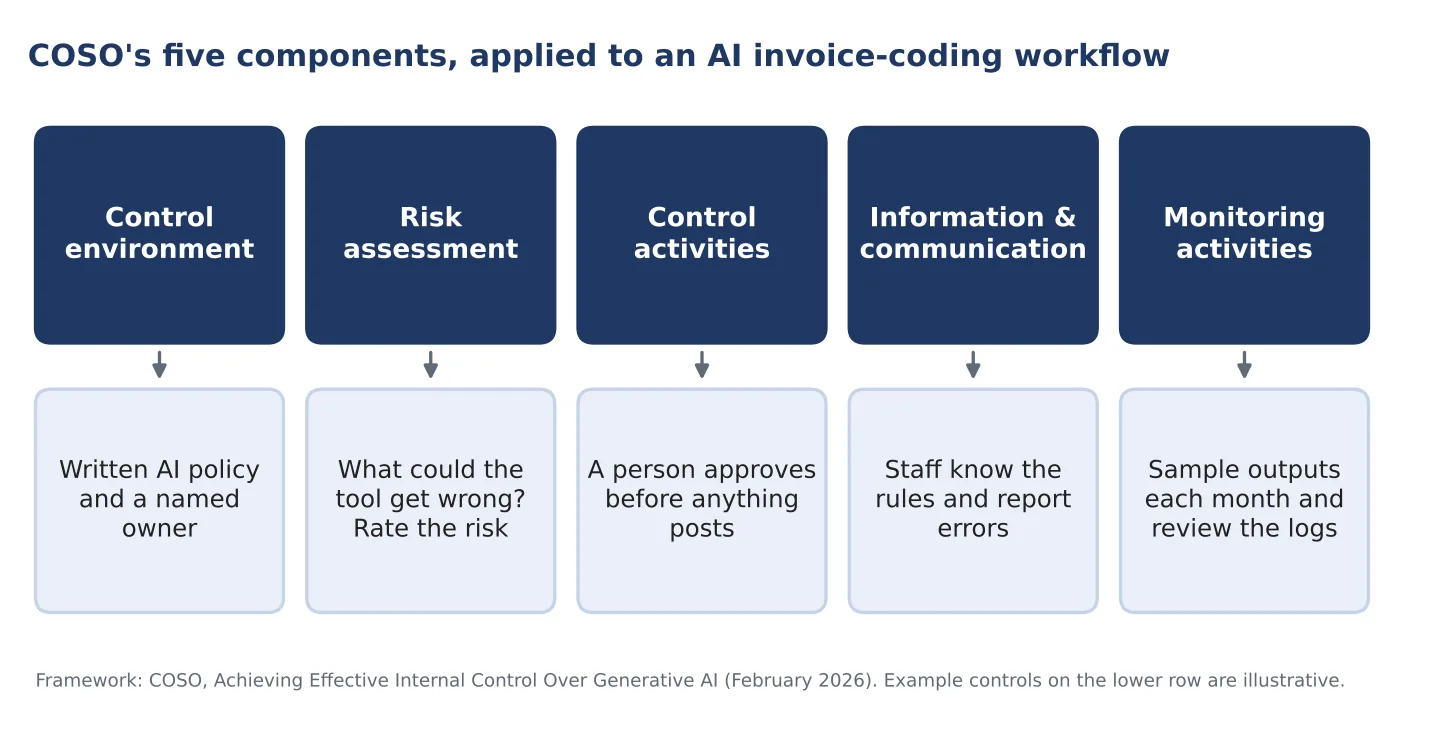
Here’s one practical way to turn those components into daily habits:
- Approved tools only. Keep a short list of what staff may use, and for what.
- Input and output review. Someone checks what goes in and signs off on what comes out.
- Change management for prompts and agents. Treat an edit to the prompt that drafts your accrual entries like a changed spreadsheet formula. Record it, test it on last month’s data, then approve it.
- Logging. Keep an audit trail of who ran what, and when.
- Periodic testing. Sample outputs on a schedule, not only when something looks off.
For SEC registrants, this ties back to internal control over financial reporting under SOX Section 404.
Client Data, Confidentiality and Privacy Rules
Suppose a staff member wants an AI tool to summarize a client’s signed return. Before anything gets pasted, ask one question: do we have a contract or consent that covers this tool? If the answer isn’t a clear yes, the return stays out of the prompt. Four sets of obligations sit behind that question.
AICPA Code. Under ET 1.700.001 and ET 1.700.040, sharing confidential client information with a third-party service provider calls for a confidentiality contract with that provider or the client’s specific consent.
IRC Section 7216. The Journal of Accountancy notes that Section 7216 requires client consent for most disclosures of tax return information. According to The Tax Adviser, consent must come before the disclosure and can be revoked, and disclosures outside the US almost always need it. The details and exceptions matter, so check the regulations or ask counsel.
FTC Safeguards Rule. The FTC lists tax preparation firms among covered financial institutions. The rule expects a designated Qualified Individual, a written risk assessment, encryption, multi-factor authentication, oversight of service providers and a written incident response plan. A breach of unencrypted information on at least 500 consumers must be reported to the FTC within 30 days of discovery. That requirement has been in effect since May 2024.
IRS guidance. The IRS says that FTC rules require professional tax preparers to have security plans. Its Publication 4557 outlines the safeguards a written information security plan (WISP) should address.

The practical rule is simple. No client names, identification numbers or returns go into a consumer chatbot. Ask for a business tier with no-training terms and a current SOC 2 report. UK and EU readers also face UK GDPR and GDPR. Take that guidance from the ICO or the relevant EU regulator, not from an article like this one.
Will AI Replace Accountants?
The evidence so far says no. The Bureau of Labor Statistics projects employment of accountants and auditors to grow 5% from 2025 to 2035, faster than average, with about 115,300 openings a year. Median pay was $83,680 in May 2025. BLS adds that AI may automate some routine tasks. It doesn’t expect that to reduce overall demand, and it says advisory and analytical work becomes more central.
Picture a bookkeeper who used to key in 300 receipts a week. Now she reviews the exceptions and spends her saved hours explaining cash flow to clients. Her title hasn’t changed, but her week has.
The worry is still fair. Recall the 37% of accountants in the Choi and Xie survey who were uneasy about job stability. A national projection can’t tell you whether your own tasks are safe, and routine work is exactly where the pressure lands.
How to Adopt AI in Your Accounting Practice: Step by Step
A rollout that keeps you compliant doesn’t need to be elaborate. It needs to be deliberate.
- Pick one or two high-volume tasks. A firm might begin with invoice coding or bank-feed categorization, since both are repetitive and easy to check.
- Write an AI use policy. Start from the AICPA small-firm template if you’re a member, and trim it to how your firm actually works.
- Classify your data. Decide what counts as client personal information and ban it from consumer tools.
- Vet vendors. Ask for a SOC 2 Type II report. Get written terms on whether your data trains their models and where it’s stored. Check how they meet service-provider duties under the Safeguards Rule.
- Build human review and sign-off. Use the COSO-based checklist above, and name who signs off on what.
- Train your people. Cover hallucinations and automation bias with real examples from your own files.
- Measure and revisit. Track hours saved, days to close and error rate, then review every quarter.
For the wider playbook, see how to automate your business with AI.
Best AI Tools for Accountants (Quick Overview)
Tools fall into a handful of categories: ledger and bookkeeping AI, document capture, accounts payable, practice management, tax research, spreadsheet copilots and business-tier chatbots. A two-person firm might start with a spreadsheet copilot and a business-tier chatbot before buying anything bigger. Which fits depends on your size, your software stack and your data rules. We review current options in our guide to the best AI tools for accountants.
FAQ
How is AI used in accounting?
Mostly on high-volume work: categorizing transactions, reading invoices and receipts, matching bank lines, flagging odd entries and speeding up research. Judgment calls and sign-off stay with the accountant.
Will AI replace accountants?
The evidence so far points the other way. BLS projects 5% job growth for accountants and auditors from 2025 to 2035, while expecting some routine tasks to be automated and advisory work to grow.
Is it safe to put client data into ChatGPT or other AI tools?
Not through a consumer account. Client information carries confidentiality duties, and tax return data adds Section 7216. Use a business tier with no-training terms, a current SOC 2 report and a signed agreement, and get client consent where the rules call for it.
What does the AICPA say about using generative AI?
The AICPA & CIMA released a small-firm generative AI policy template in April 2026 for members. Your binding obligations come from the Code of Professional Conduct, especially the confidentiality rule and the third-party service provider interpretation.
What skills do accountants need to work with AI?
Clear prompting, an eye for output that is plausible but wrong, a feel for data quality, and the habit of documenting your review. Professional skepticism and plain-spoken client communication stay at the core of the job.
Bottom Line
Use AI for the repetitive layers of accounting, keep judgment and sign-off human, and write down your controls and client consent. The standard setters aren’t asking you to avoid the technology, only to stay responsible for what it produces. For next reads, try the best AI tools for accountants, how AI is changing auditing, our page on AI tax software and AI in personal finance. This week, pick one task, draft a one-page AI policy and run a small pilot.
Was this article useful?
Thanks, that helps us decide what to write next.
Spotted a mistake? Report an error and we will fix it, with a dated correction note.
Disclaimer. This article is general information, not financial, tax, or investment advice. Figures describe specific cases at specific dates. Talk to a licensed professional before acting on anything here. Full disclaimer.