AI vs Financial Advisor: Which Should You Choose?
Educational information only. This article is general education, not individualized investment advice. Fees and minimums are as of October 2026 and can…
Educational information only. This article is general education, not individualized investment advice. Fees and minimums are as of October 2026 and can change.
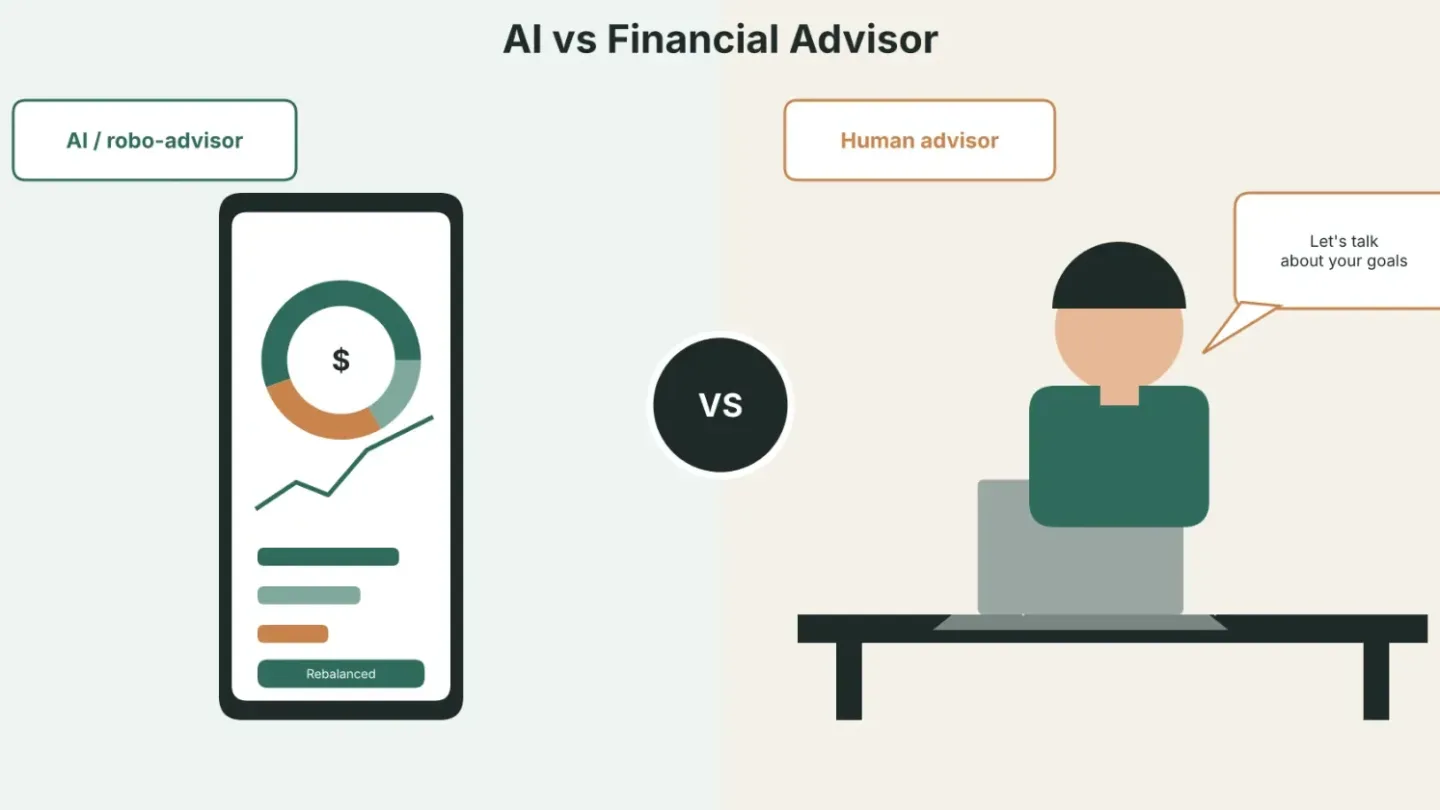
The AI vs financial advisor question looks like a two-way fight, but there are three options on the table. A chatbot, a robo-advisor and a human advisor can all seem helpful on your screen, yet they answer to very different rules. Here is the short version: automation fits simple, long-term investing, a fiduciary human earns the fee when a decision is complicated or costly to get wrong, and a hybrid sits in the middle. Every fee and legal duty below comes from a regulator page or a provider disclosure, and each one is linked.

AI vs Financial Advisor: The Quick Verdict
Short on time? This table is the answer. The detail behind each cell comes right after it.
| General AI chatbot | Robo-advisor | Human advisor | |
|---|---|---|---|
| What it does | Explains concepts, runs numbers, answers questions | Builds and manages a portfolio from a questionnaire | Personal planning and ongoing guidance |
| Typical cost model | Varies by product; no advisory fee | Percent of assets, such as 0.25% at Betterment Digital and Wealthfront | Percent of assets, flat fee, hourly or commission, depending on the person |
| Regulated as | Not registered as an investment adviser | SEC- or state-registered investment adviser; files Form ADV | Registered investment adviser or broker-dealer representative |
| Legal duty to you | None | Fiduciary duty under the Investment Advisers Act | Fiduciary duty (adviser) or Regulation Best Interest (broker) |
| Human access | None | Sometimes, on premium tiers | Yes |
| Best for | Learning and double-checking math | Simple goals and smaller balances | Complex or high-stakes decisions |
What “AI Financial Advisor” Actually Means
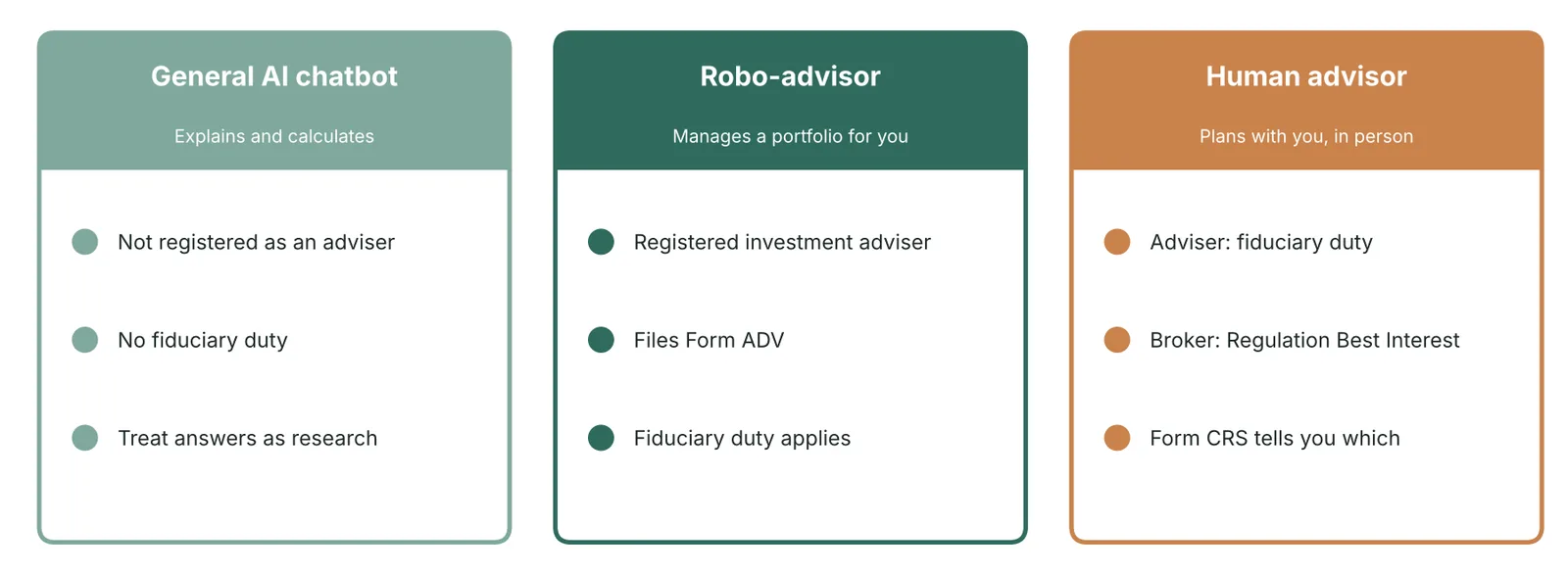
Type “AI financial advisor” into a search bar and you get three different products sold under one label. A quick example shows the gap. Say you are wondering whether to roll an old 401(k) into an IRA. A chatbot will walk you through the trade-offs in general terms. A robo-advisor will fold the question into a portfolio built from your questionnaire answers. A human advisor can look at your whole situation, and if that person is a broker or a registered investment adviser, a legal standard governs what they recommend.
One spelling note before we go on. This article writes “advisor” in everyday use and “adviser” when naming the legal category, which is how the SEC does it.
General AI chatbots (ChatGPT, Gemini, Claude)
Chatbots are great at explaining what an expense ratio is, showing how compounding works or checking your arithmetic. What they are not is a registered investment adviser. A January 2024 SEC, NASAA and FINRA investor alert warns that AI-generated information “might rely on data that is inaccurate, incomplete, or misleading.”
Treat a chatbot answer as research you still have to confirm. If you are also weighing apps that bundle AI features, our guide to AI investing apps covers that side.
Robo-advisors
A robo-advisor builds and manages your portfolio from an online questionnaire. Unlike a chatbot, it is a regulated business. According to the SEC’s 2017 investor bulletin on robo-advisers, these firms must follow the securities laws that apply to SEC- or state-registered advisers, and they must file Form ADV like any traditional adviser.
There is a built-in limit, though. The recommendation is “limited by the information it requests and receives from you,” so if the questionnaire misses something big, so does the portfolio. For the mechanics, see how robo-advisors use AI.
Human financial advisors: RIAs vs brokers
The phrase “financial advisor” covers people who work under different legal standards. A registered investment adviser (RIA) is a fiduciary under the Investment Advisers Act of 1940. A broker-dealer representative recommending investments to a retail customer follows Regulation Best Interest instead. The accountability section below shows why that gap matters.
Cost: AI vs Financial Advisor Fees Compared
Price is where most people start, and also where numbers get misread. The same SEC bulletin points out that you may owe other costs on top of the adviser’s fee, such as management fees on the ETFs bought for your account. The headline percentage is rarely the whole bill.
What robo-advisors charge (prices as of October 2026)
| Service | Advisory fee | Conditions and notes |
|---|---|---|
| Betterment Digital | 0.25% a year | For balances of $24,000 to $1 million, or $200+ in monthly recurring deposits. Otherwise $5 a month. |
| Betterment Premium | 0.65% a year | Includes access to financial consultants. |
| Wealthfront | 0.25% a year | $500 to get started. |
| Vanguard Digital Advisor | 0.20% gross for all-index portfolios, 0.25% for an active/index mix | $100 minimum. Vanguard’s page also shows roughly $15 to $16 per $10,000 invested; read its footnotes on how the figures relate. |
| Vanguard Personal Advisor | 0.35% gross for all-index portfolios, 0.40% for an active/index mix | $50,000 minimum. Hybrid service that includes human advisors. |
Sources: Betterment fee disclosure (updated May 5, 2026), Wealthfront and Vanguard pages, all checked October 14, 2026. Ask each provider how underlying fund costs are charged.
How human advisors charge
Human advisors use four main models: a percentage of assets, a flat fee, an hourly rate or commissions. The SEC’s bulletin on fees and expenses notes that an adviser managing your portfolio may charge an ongoing annual fee based on its value.
You will see “average advisor fee” numbers all over the web, but many never trace back to a primary survey, so none appear here. Do this instead: ask for any quote in dollars at your balance. A hypothetical 0.50% fee on $400,000 is $2,000 a year, and written that way it is much easier to compare.
Why a fraction of a percent adds up
The same SEC bulletin gives a clean example. Take $100,000 growing 4% a year for 20 years. With a 0.25% annual fee you end up with about $208,000. At 0.50% it is about $198,000, and at 1.00% about $179,000. The gap between the cheapest and priciest case comes to roughly $29,000.
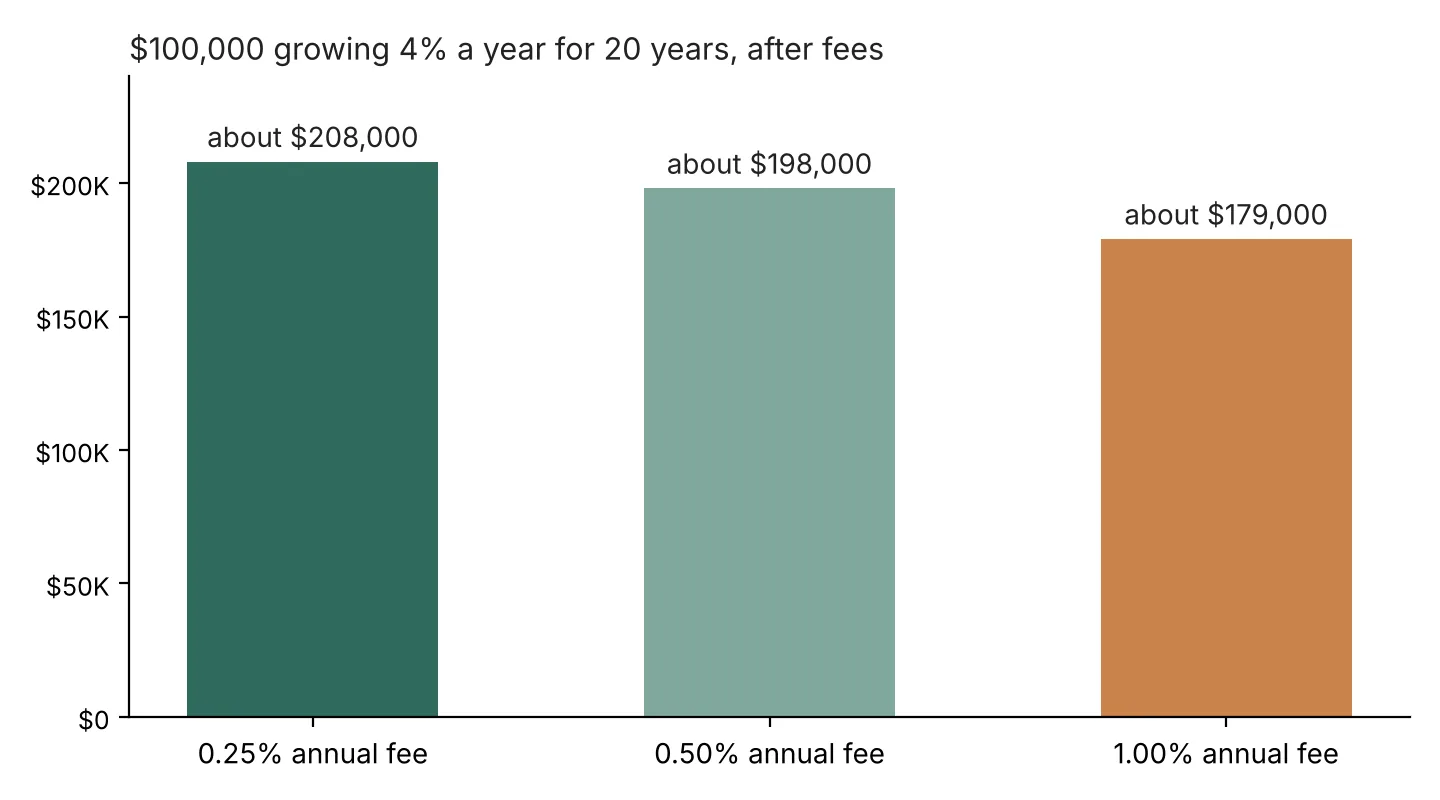
Figures from the SEC Investor Bulletin on fees and expenses (July 23, 2025). The $29,000 gap is the difference between the two rounded SEC figures. Illustration only, not a forecast.
The small-account trap: flat subscription fees
A flat monthly fee looks harmless until you divide it by a small balance. In its 2023 subscription-fee bulletin, the SEC uses a $500 account: $3 a month adds up to $36 a year, which is more than 7% of the account’s value.
The same math can catch you at real providers. Betterment Digital charges $5 a month when the balance is under $24,000 and there is no $200 monthly deposit. On a $1,000 balance, that is $60 a year, or 6%. Before you commit to any plan billed monthly, convert the price to a yearly percentage.
Who Is Accountable? Fiduciary Duty, Reg BI and AI
The biggest gap among these three options is legal accountability, not intelligence. Who owes you what decides who you can hold responsible when advice goes wrong.
Investment advisers: fiduciary duty
A fiduciary financial advisor, meaning a registered investment adviser, owes you two duties under the Investment Advisers Act of 1940. An August 2022 SEC staff bulletin spells them out. The duty of loyalty means eliminating conflicts of interest or fully and fairly disclosing them. The duty of care means giving advice that is in your best interest, based on a reasonable understanding of your objectives.
Registered robo-advisors are investment advisers too, so both duties apply to them as well.
Brokers: Regulation Best Interest
Brokers work under a different rule. According to FINRA, Regulation Best Interest requires a broker-dealer to act in your best interest, not its own, when recommending securities, account types or strategies to a retail customer. That includes something like an IRA rollover. The SEC staff bulletin lists four parts: disclosure, care, conflict of interest and compliance.
Both brokers and registered advisers give you a Form CRS, a short relationship summary covering services, fees, conflicts, standard of conduct and disciplinary history. FINRA’s page does not compare Reg BI with the adviser fiduciary duty, and the two differ in scope, so read each firm’s summary rather than assuming.
Where general AI chatbots fit
A consumer chatbot is not registered as an investment adviser and owes you no fiduciary duty. There is no Form ADV to read and no registered professional behind the answer. The AI investor alert also cautions about AI-themed investment scams, another reason to use chatbot output as research only.
What AI Does Better Than a Human Advisor
Cost is the obvious win. A $500 starter account at Wealthfront pays 0.25%, which is $1.25 a year in advisory fees before any fund costs. That is hard to match with a person on payroll.
Automation is the second edge. Software rebalances on schedule without forgetting, and some services offer tax-loss harvesting; Wealthfront’s page promotes it. The SEC suggests asking any robo-advisor whether it uses harvesting and how often it rebalances. To go deeper on what software can handle, read can AI manage your money.
What a Human Advisor Does Better Than AI
Picture a founder who sells her company. In one year she has a lump sum, a large tax bill and a pile of decisions about what comes next. Add an inheritance, a divorce, stock compensation, estate questions across state lines or the order in which to draw down retirement accounts, and a questionnaire stops being enough. A person can weigh trade-offs, ask follow-up questions and keep you steady when markets drop.
Access matters too. The SEC warns that with some robo-advisors there may be no conversation with a person at sign-up or afterward. Hybrids fill that gap: Betterment Premium and Vanguard Personal Advisor, which starts at $50,000, both put humans in the loop.
Which Should You Choose? A Scenario-Based Verdict
Find the row that sounds like you. Each verdict is direct.
| Your situation | Verdict | Watch for |
|---|---|---|
| New investor, small balance, simple goal | Use a robo-advisor | Flat monthly fees that eat a tiny balance |
| DIY learner who likes to understand things | Use a chatbot for education, plus low-cost index funds | Verify every number and claim yourself |
| Growing assets, a few big decisions ahead | Go hybrid, or hire a fiduciary hourly or flat-fee | Ask for the price in dollars |
| Business owner, large inheritance or close to retirement | Hire a fiduciary human adviser | Confirm the adviser is a registered fiduciary |
| Anyone, any time | Never act on a chatbot’s specific buy or sell call | Specific calls come with no accountability |
How to Check Any Advisor, Human or Robo, Before You Sign
Five minutes of checking screens out most of the worst outcomes.
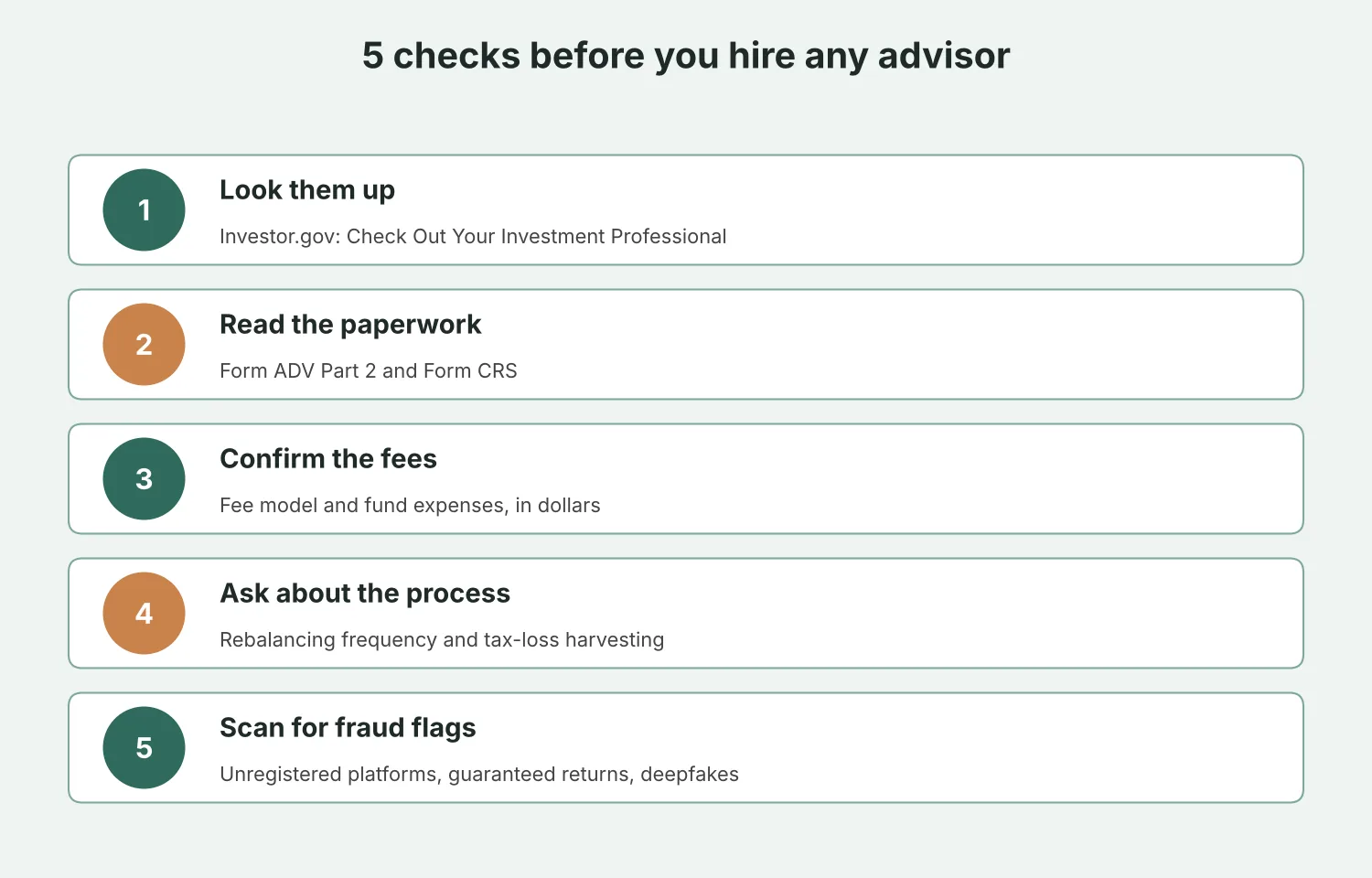
- Look them up. Search the person or firm with Investor.gov’s Check Out Your Investment Professional tool.
- Read the paperwork. Open Form ADV Part 2 and the Form CRS.
- Confirm the fees. Get the fee model and the fund expenses, both in dollars at your balance.
- Ask about the process. How often is the portfolio rebalanced, and is tax-loss harvesting offered?
- Scan for fraud flags. The AI investor alert names unregistered platforms, guaranteed returns and deepfake promotions.
FAQ
Can AI replace a financial advisor?
For simple investing, partly. Automation can build and rebalance a portfolio cheaply. It cannot take legal responsibility for your results, and complicated situations still call for a person.
Is a robo-advisor a fiduciary?
A robo-advisor registered with the SEC or a state is an investment adviser, so the Advisers Act duties of care and loyalty apply. Its advice still depends on what its questionnaire collects from you.
Is it safe to use ChatGPT for financial advice?
It works well as a tutor and a second pair of eyes on your math. It is not a registered adviser, owes you no fiduciary duty and can produce information that is inaccurate or incomplete. Skip any specific buy or sell suggestion.
How much does a robo-advisor cost compared with a human financial advisor?
The published robo-advisor rates in the table above run from 0.20% to 0.65% a year as of October 2026, and Betterment adds a $5 monthly fee on smaller balances without a recurring deposit. Human advisors use percentage, flat, hourly or commission models, so ask for a quote in dollars and set it against the SEC’s 20-year fee example.
Do any robo-advisors let you talk to a human?
Yes. Betterment Premium includes access to financial consultants, and Vanguard Personal Advisor adds human advisors at $50,000 or more. Not every robo-advisor offers this, so check before you sign up.
Bottom Line
Use AI and automation for low-cost, simple investing and for learning. Pay a fiduciary human when the decision is complex or the stakes are high, and consider a hybrid for everything between. Whichever route you lean toward, run the five checks above before you hand over any money. The wider picture lives in our guide to AI in personal finance.
This article is educational and is not individualized investment advice.
Was this article useful?
Thanks, that helps us decide what to write next.
Spotted a mistake? Report an error and we will fix it, with a dated correction note.
Disclaimer. This article is general information, not financial, tax, or investment advice. Figures describe specific cases at specific dates. Talk to a licensed professional before acting on anything here. Full disclaimer.