How to Make Money Selling AI Prompts (2026 Guide)
What makes an AI prompt worth paying for, where to sell it and how to package and price it.

Not financial advice. This guide is for general education, based on publicly available information about AI prompt marketplaces as of 2026. It isn’t a guarantee of any income outcome, and marketplace rules and pricing change — confirm current terms directly with each platform before you list anything.
Wondering how to sell AI prompts in 2026? Back in 2023, a single well-worded prompt felt like a small piece of magic, and people paid for it. Today ChatGPT, Claude, and Gemini handle plain-language requests well, and free prompt lists are everywhere, so a single clever sentence is hard to sell. If you’re picturing one-off packs like “50 ChatGPT Prompts for Productivity,” expect a crowded, low-price market. The better bet is different: tested, niche-specific prompt systems built around a real, repeatable job — a real estate agent who needs consistent listing descriptions, a Shopify seller who needs product copy at scale, an illustrator who wants a reliable Midjourney style. This guide covers what makes a prompt worth paying for, where to actually sell it, and how to price and package it as a real product.
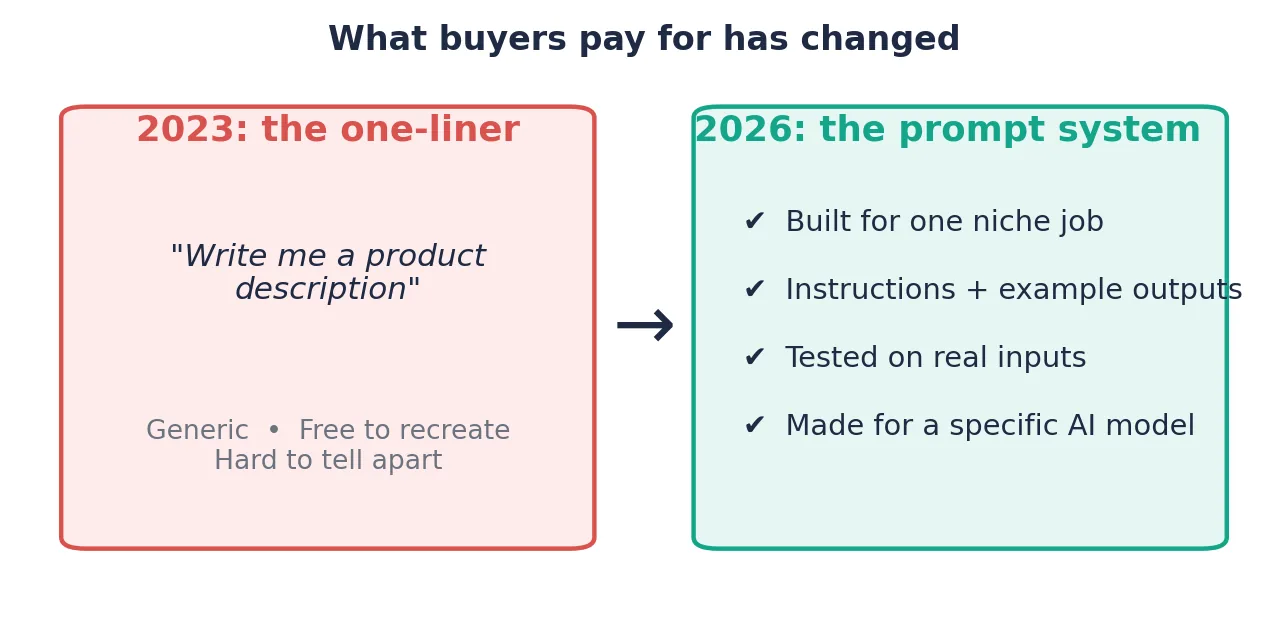
In 2026, buyers pay for tested systems, not clever one-liners.
Can You Really Make Money Selling AI Prompts?
Yes, but the buyer has changed. It’s rarely a curious hobbyist paying a few dollars for a single prompt anymore — it’s usually a small business owner, freelancer, or content creator paying for a system that reliably produces a specific output they need again and again. Individual sellers with a focused, well-packaged prompt pack in a specific niche can build a genuine side income; broad, generic “AI prompts for everything” packs tend to underperform badly.
What Makes a Prompt Worth Paying For
Four traits separate a sellable prompt from a forgettable one:
- Reusable — it works across many inputs, not just one example
- Specific — built for one job (writing a product description, drafting a client email), not a vague “help me be more productive”
- Outcome-driven — the buyer can see, from your demo output, exactly what they’ll get
- Tested — you’ve actually run it multiple times and refined it, not just written it once and listed it
A prompt pack that includes instructions and example outputs alongside the prompt itself sells noticeably better than the raw prompt text alone.

Where to Sell AI Prompts
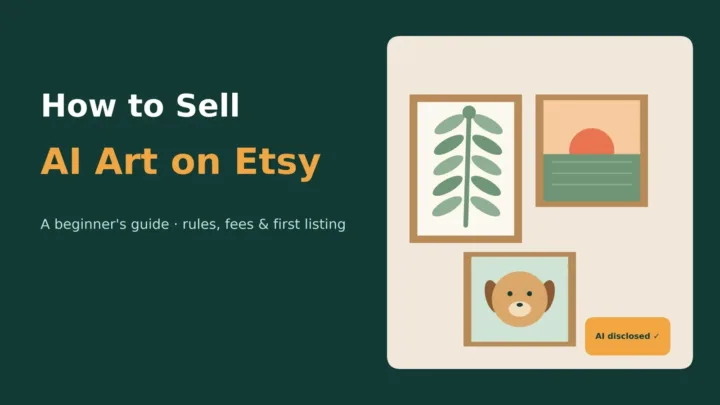
One important correction before you pick a platform: Etsy no longer allows standalone prompt sales. Etsy’s Creativity Standards explicitly prohibit selling “AI prompt bundles” on their own — the policy treats a prompt as part of the creative process behind a piece of art, not a standalone product. You can still sell art made from your prompts on Etsy (see our Etsy AI art guide), just not the prompts themselves. If an older article told you Etsy is a prompt marketplace, that information is out of date.
| Platform | Best for | Notes |
|---|---|---|
| PromptBase | Image prompts (Midjourney, Stable Diffusion) and text prompts | One of the longest-running, most established prompt marketplaces, with built-in buyer traffic — but also plenty of competing listings. Its seller page says sales through your own link carry 0% fees, while sales through the marketplace carry a 20% fee (checked October 2026). |
| PromptHero | Image-generation prompts | Another marketplace for image-generation prompts; read its seller terms and fees before you list. |
| Gumroad | Any packaged prompt system | You control pricing, branding, and bundling; no built-in marketplace traffic, so you need your own audience. |
| Your own site/store | Established sellers with an audience | Best margins, but requires you to drive your own traffic. |
| Etsy | Not allowed for standalone prompts | Permitted only for finished art created from prompts. |
Most sellers start on a marketplace like PromptBase or Gumroad to validate demand cheaply, then move toward their own storefront once they know which prompt packs actually convert. If you want to go further than prompts, our guide to AI agents explains the next step up, and this guide to automating work with AI shows what business buyers want prompts for.
How to Sell AI Prompts as a Product: Packaging
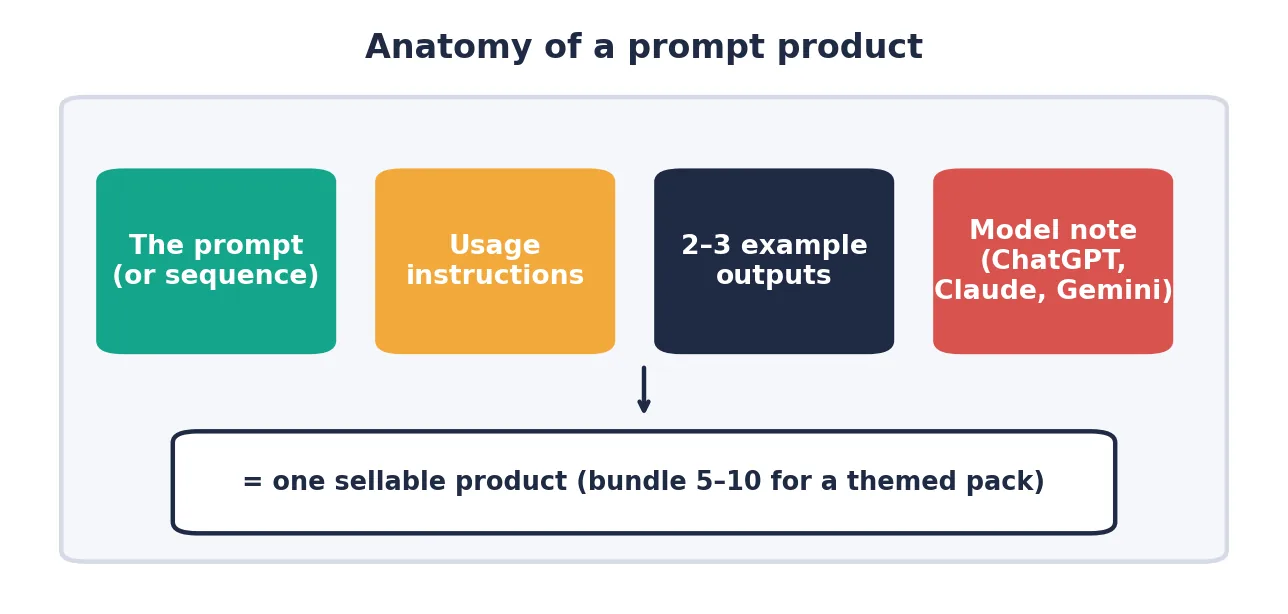
A prompt by itself is thin. A product is:
- The prompt (or prompt sequence, if it takes multiple steps)
- Clear instructions for how and where to use it
- Two or three example outputs so the buyer knows what to expect
- A short note on which AI model or tool it’s built for, since outputs vary between ChatGPT, Claude, and Gemini
Bundling five to ten related prompts into a themed pack (e.g., “Real Estate Listing Description Prompt Kit”) tends to sell better than single prompts, because it solves a recurring workflow rather than a one-time task.
How to Price Your Prompts
Pricing varies a lot by platform, but there’s only a little public data to anchor it. One seller who sampled 188 live PromptBase listings himself, in a CartMango guide, reported a median price of $5.99, with 91% of listings priced at $10 or under. That is a small sample from one author, so treat it as a rough signal, not a market statistic. There is no public dataset for packaged, multi-prompt systems sold on Gumroad or a seller’s own site, so compare similar listings and test your own price. Price by the value of the output, not the number of words in the prompt — a prompt that reliably saves a freelancer two hours a week is worth more than a longer prompt that just sounds more impressive.
How to Market Them (and Stand Out)
- Post real before/after examples of the prompt’s output on the platform where your buyer already hangs out (a Facebook group for real estate agents, a subreddit for Etsy sellers, and so on)
- Answer questions publicly about your niche — that visibility drives buyers to your listings more reliably than marketplace search alone
- Keep improving the pack based on buyer feedback, and mention updates in your listing to build repeat trust
Mistakes That Keep Sellers at $0
- Selling generic, one-line prompts with no packaging or examples
- Ignoring niche fit and trying to appeal to “everyone,” which in practice appeals to no one
- Listing on Etsy, where the listing gets removed under current policy
- Never testing the prompt yourself across multiple real-world inputs before selling it
Frequently Asked Questions
How much can you make selling prompts?
It varies widely by niche and platform — there is no reliable public data on typical earnings. The only price anchor above is one author’s sample of PromptBase listings. Treat specific income claims from other blogs as unverified unless they cite a real, checkable source. A well-packaged, niche-specific pack sold on a marketplace with built-in traffic has the best realistic shot at consistent sales.
Where is the best place to sell prompts?
PromptBase or PromptHero for image-generation prompts with built-in buyer traffic; Gumroad or your own site for packaged, branded prompt systems if you already have an audience to sell to.
Can prompts be copied or stolen?
Yes, easily — a prompt is just text. This is exactly why the packaging (instructions, examples, ongoing updates) matters more than the raw prompt: it’s what a copy-paste competitor can’t replicate as easily.
Do people still buy prompts in 2026?
Yes, but the buyer profile has shifted from curious individuals to business users buying a tested workflow, not a novelty.
Conclusion
Selling AI prompts still works in 2026 — it just isn’t the “list a clever sentence, watch the money roll in” business it briefly looked like in 2023. Pick one specific buyer and one specific recurring job, package the prompt with real instructions and proof it works, and choose a marketplace that actually allows the listing (Etsy doesn’t).
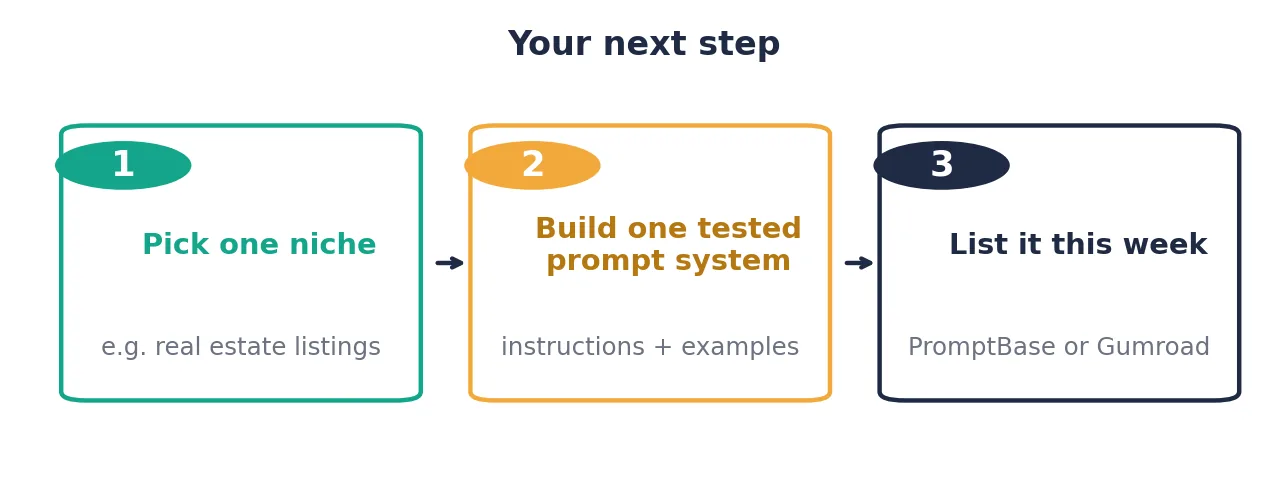
Your next step: pick one niche, build one tested prompt system, and list it on PromptBase or Gumroad this week. That’s a stronger start than spending another week planning the perfect catalog.
Was this article useful?
Thanks, that helps us decide what to write next.
Spotted a mistake? Report an error and we will fix it, with a dated correction note.