How to Start an AI Automation Agency in 2026: The Founder’s Guide
What an AI automation agency really sells, what to charge, and how to land your first client.
Most search results for starting an AI automation agency suffer from a two-audience problem: they either push a paid course full of recycled revenue screenshots, or they evaluate vendors from a corporate buyer’s perspective. This guide is built strictly for the founder. It skips the hype to give you a consolidated pricing table, a clear distinction between consulting and agency models, and an honest answer on market saturation — here’s exactly what it takes to build a profitable operation this year.
What an AI automation agency actually is (and isn’t)
Many beginners mistake an AI agency for a prompt engineering service. That’s a fundamental error. You are building systems that replace manual human effort with automated logic.
What you’re really selling (outcomes, not AI access)
Clients do not care about the underlying language model. They don’t care if you use OpenAI, Anthropic, or an open-source alternative — they only care about business outcomes. You are selling time saved, errors reduced, and revenue recovered.
If a sales team spends twenty hours a week qualifying leads, your automation gives them those hours back. You are selling the elimination of a bottleneck; the AI is simply the engine making that outcome possible. Frame every pitch around the financial value of the solved problem, never the novelty of the technology.
AI automation agency vs. AI automation consultant
The market often confuses agencies with consultants. As a founder, you must choose your path early — these are different business models requiring distinct skill sets and scaling strategies.
| Feature | AI Automation Agency | AI Automation Consultant |
|---|---|---|
| Primary Deliverable | Done-for-you builds and active maintenance. | Strategy, roadmaps, and advisory sessions. |
| Revenue Model | High initial setup fee plus recurring monthly retainer. | Hourly rate or a flat strategic project fee. |
| Scaling Path | Requires hiring a small team as client load grows. | Solo execution with strictly capped bandwidth. |
| Client Relationship | Long-term execution partner handling ongoing fixes. | Short-term advisor pointing the internal team in the right direction. |
An agency builds and maintains the machine. A consultant draws the blueprint. If you want recurring revenue, the agency model is your target.
Is this business model still worth starting in 2026?
You have likely seen promotional growth statistics promising a massive gold rush. The reality is more nuanced, but highly profitable for those who execute well — the market is not saturated with competent builders; it’s saturated with loud beginners.
Look at the adoption-versus-impact gap. According to McKinsey’s State of AI in 2026 survey, nearly nine in ten respondents report regular use of AI in at least one business function, but only 37% attribute at least some Earnings Before Interest and Taxes (EBIT — a common measure of a company’s core operating profit) impact to AI use. That gap between adoption and actual financial impact is your entire business model: companies bought the tools but don’t know how to connect them to their bottom line.
The AI automation agency business model, step by step
Understanding the mechanics of your business is more important than mastering the tech stack. A brilliant automation without a profitable business model will bankrupt you quickly. You need a structured approach to building, delivering, and charging for your work.
What a typical first build looks like
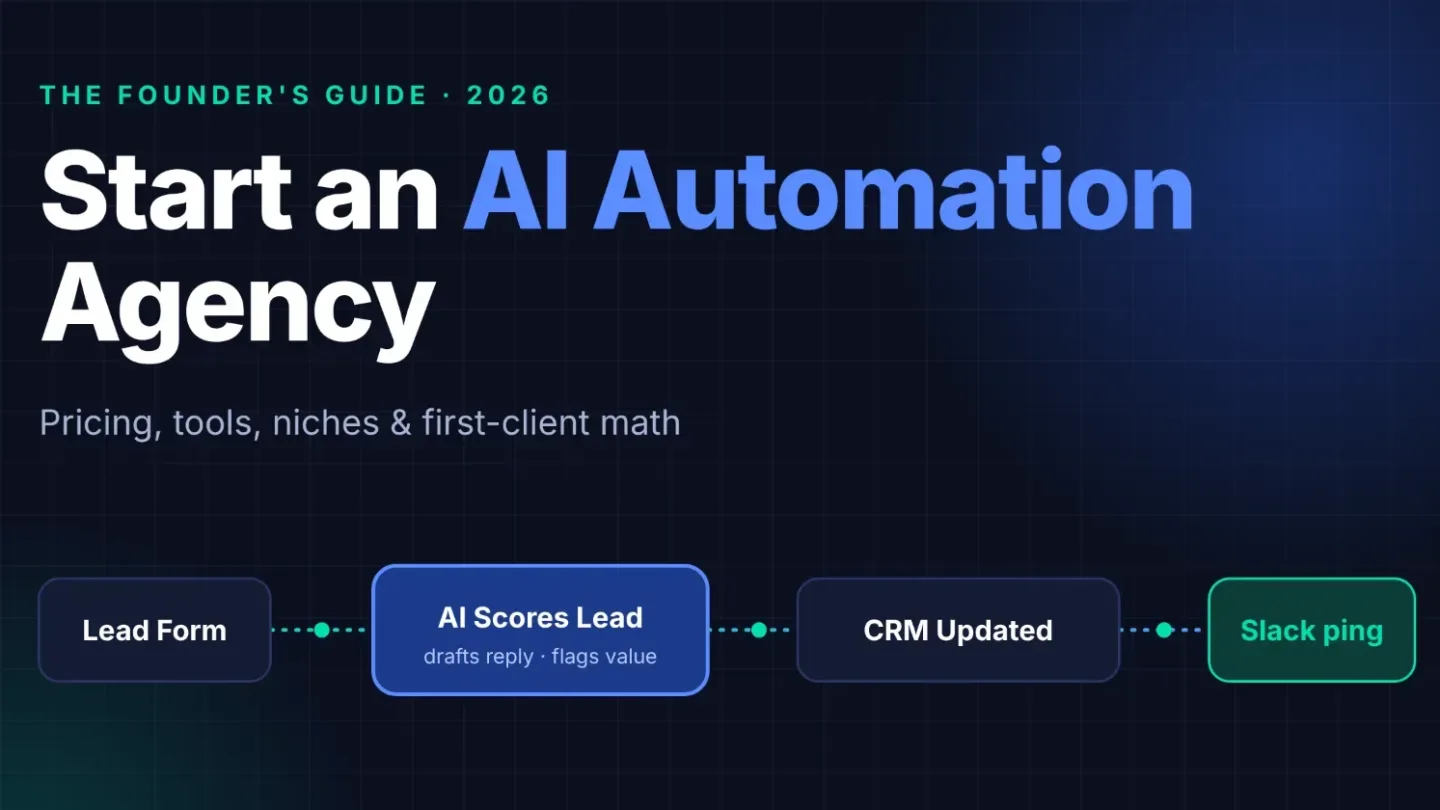
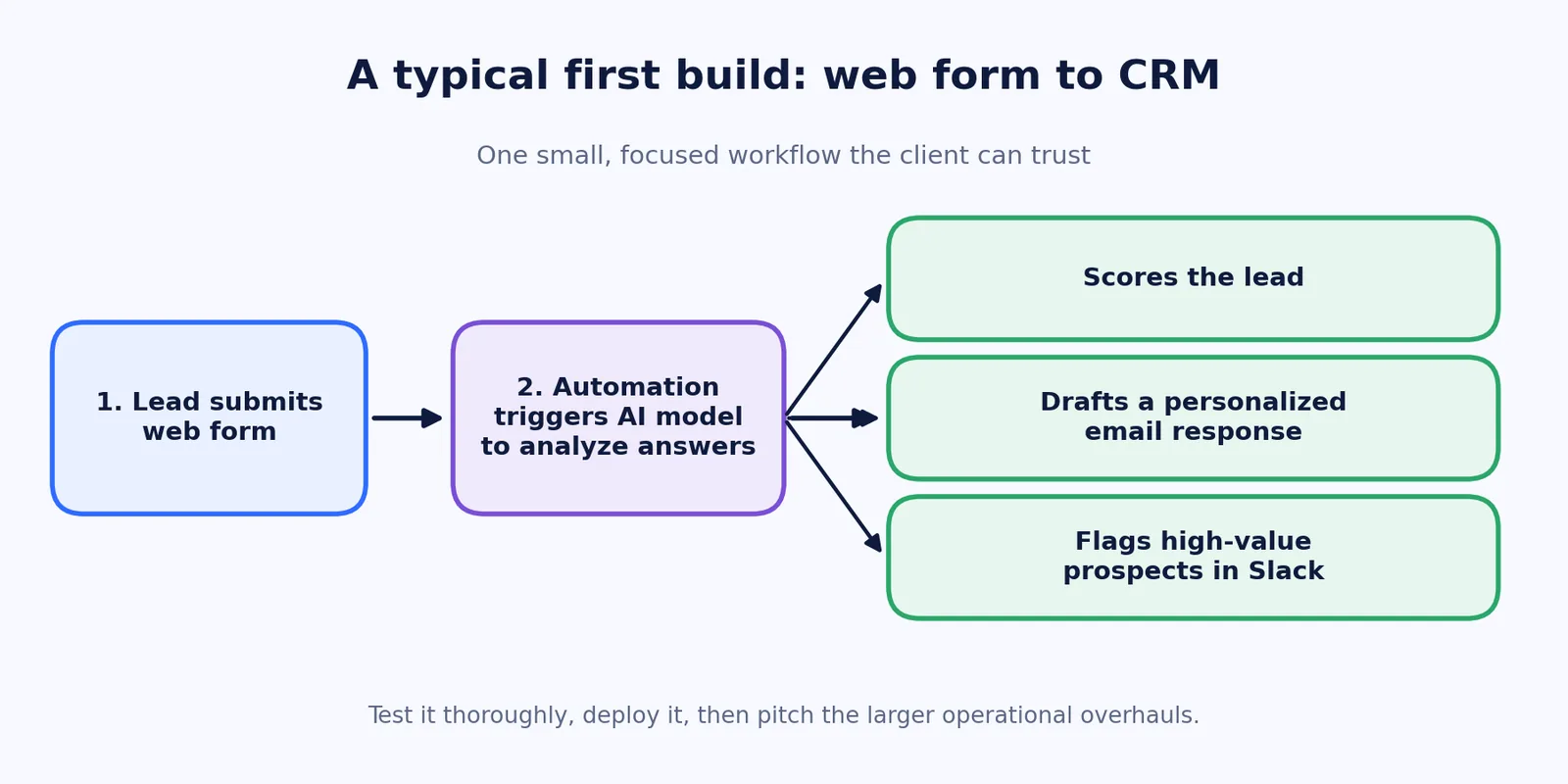
Your first client build should never be a massive, company-wide overhaul. Keep it highly focused — a typical first project involves connecting a client’s web form to their Customer Relationship Management (CRM) tool.
When a lead submits the form, the automation triggers an AI model to analyze the answers. It scores the lead, drafts a personalized email response, and flags high-value prospects in Slack. You build this single workflow, test it thoroughly, and deploy it. Once the client trusts this small win, you pitch the larger operational overhauls.
How agencies actually get paid (project fee + retainer model)
Profitable agencies do not charge by the hour. They use a hybrid pricing structure: a large, one-time project fee to build the automation architecture, covering the heavy lifting of mapping processes, building logic, and testing edge cases.
Following the initial build, you transition the client to a recurring monthly retainer. Software breaks. APIs update. Workflows require optimization. The retainer ensures you’re compensated for keeping their critical systems running smoothly.
While it is not entirely passive income with AI, this predictable recurring revenue is what makes the agency model sustainable and eventually sellable.
Services to offer clients (your services menu)
Do not tell clients you “do AI automation.” Give them a clean, named menu of specific services — this bridges the gap between their daily frustrations and your technical solutions.
- Lead Qualification & Routing: Automatically scoring inbound prospects and assigning them to the right sales representatives based on intent data.
- AI Customer Support Automation: Handling Tier 1 query resolution via trained chatbots, escalating only complex issues to human agents.
- CRM Data Automation: Syncing records across disjointed platforms to eliminate manual data entry.
- Reporting Workflows: Auto-generating dynamic client dashboards and weekly summary emails without human intervention.
- Content Workflows: Utilizing AI writing to generate first-draft social media assets or localized copy based on core brand guidelines.
Presenting these as distinct, packaged services removes the cognitive load for the buyer — they can point to exactly what hurts their business and buy the specific cure.
How much to charge (AI agency pricing)
Pricing is the number one hurdle for new founders. The numbers online are scattered, inconsistent, and often inflated to sell a dream. Below is real-world pricing data from active agencies and industry pricing guides, with sources linked so you can verify it yourself.
Consolidated, sourced pricing table
Pricing depends heavily on the complexity of the workflow and the size of the client. Avoid the trap of charging $500 for a build that saves a company $50,000. Here’s how current market players and industry pricing guides structure their fees.
| Source | Setup / Audit Fees | Retainer / Rollout Fees |
|---|---|---|
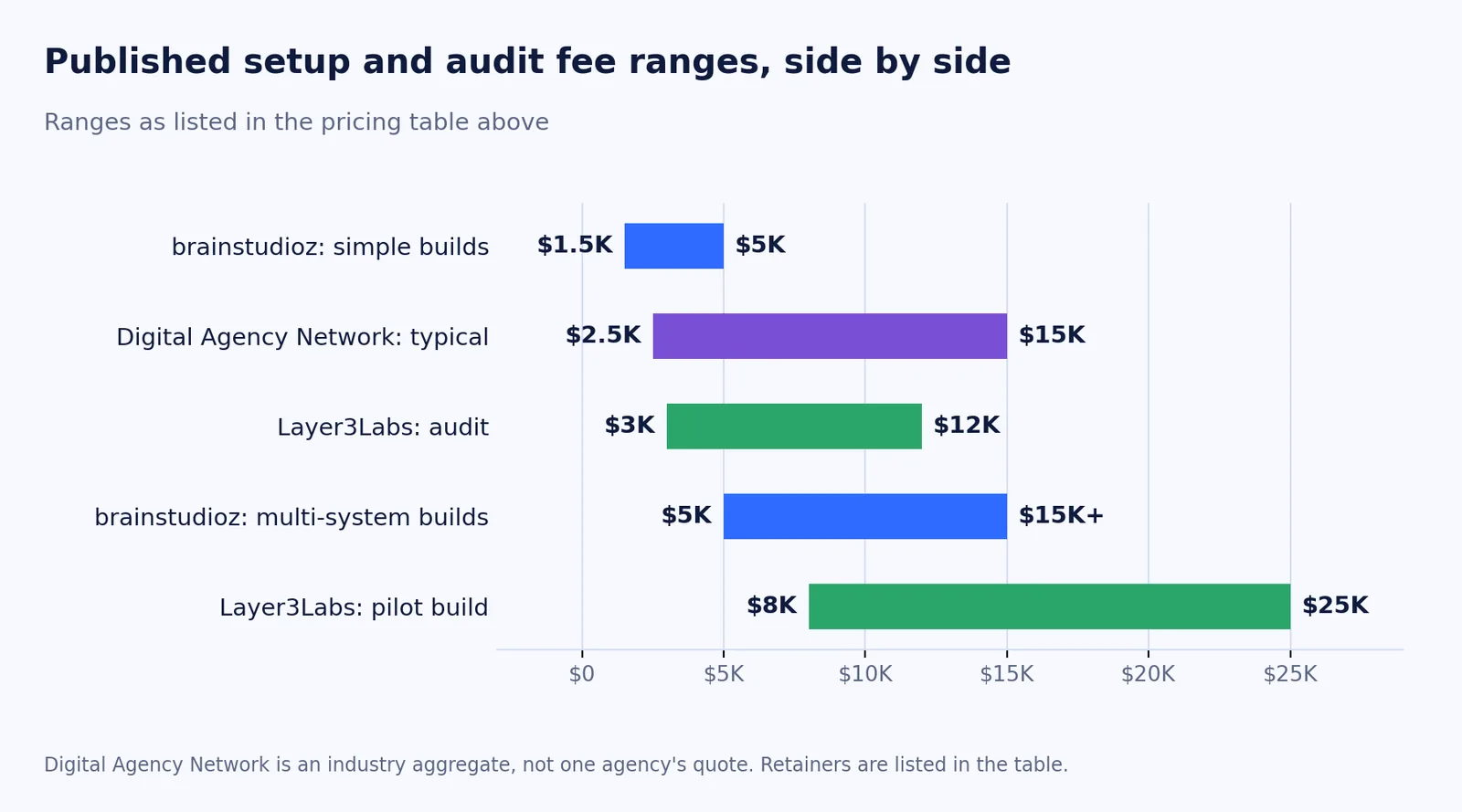
| Layer3Labs | $3K–$12K (audit), $8K–$25K (pilot build) | $15K–$75K (production automation), $75K+ (complex multi-workflow rollout), $1.5K–$8K/month (support retainer) |
| brainstudioz | $1.5K–$5K (simple builds), $5K–$15K+ (multi-system integrations) | $500–$2K/month retainer |
| Digital Agency Network (2026 pricing guide) | $2.5K–$15K (typical AI automation setup) | $500–$5K+/month (ongoing monitoring and maintenance) |
A note on sourcing: these are published guides, not price sheets. Layer3Labs is written for businesses hiring an agency, brainstudioz is a guide to starting one, and Digital Agency Network is an industry pricing guide. Treat the figures as market ranges, not quotes. Freelance-marketplace listings were left out because individual freelancer prices change too often to serve as a reference.
Use this table as your compass. A beginner should aim toward the brainstudioz tier: charge a few thousand dollars upfront, followed by a mid-three-figure monthly retainer to cover hosting and maintenance.
How to price to value instead of tool cost
The fastest way to fail is pricing based on your software costs. If your Zapier subscription costs $40 a month, charging a client $100 for a workflow makes logical sense to a novice — this is a fatal mistake.
You must price based on the value generated. If your customer support automation replaces the need to hire an entry-level employee (illustrative example: a $45,000-a-year role), your $5,000 setup fee is incredibly cheap by comparison. Anchor your pricing against their payroll or their lost revenue, never against your software overhead.
The tools and platforms you need
You do not need to build proprietary software — you are an integration specialist. Your job is to make existing platforms talk to each other seamlessly. Choosing the right central hub is critical to your profit margins.
n8n vs. Zapier vs. Make
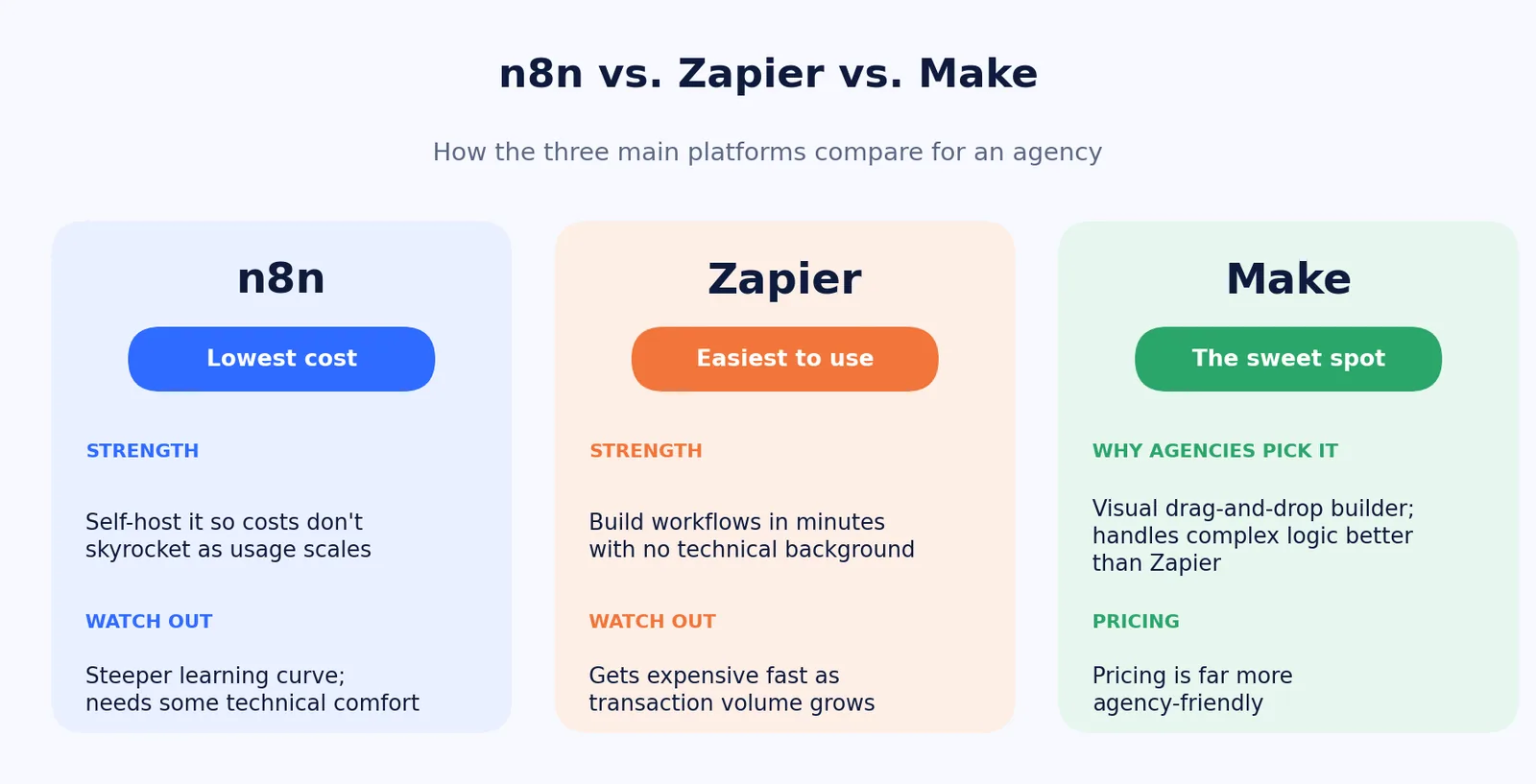
These three platforms dominate the automation agency space. Each has distinct advantages depending on your technical background and client budget. For a full comparison, see n8n vs Zapier vs Make, and for your first client build, how to automate a business with AI.
- n8n: Often the lowest-cost option because it can be self-hosted, so costs may not climb as client usage grows — but it has a steeper learning curve, and you should read n8n’s license terms before you host it for clients.
- Zapier: The undisputed king of ease-of-use. You can build workflows in minutes without any technical background. The downside is cost — Zapier gets expensive fast as transaction volume increases, eating directly into your retainer margins.
- Make (formerly Integromat): The sweet spot for most modern agencies. It has a highly visual drag-and-drop builder and handles complex logic better than Zapier, with pricing that’s far more agency-friendly.
Do you need to know how to code?
No, you do not need to be a software engineer. The primary tools are visual, no-code builders. However, understanding basic coding concepts gives you a real advantage.
You need to understand how APIs (the connections that let different pieces of software send each other data) work, and grasp basic logic principles like if/then statements, webhooks (automatic notifications one system sends another when something happens), and JSON (a common, simple text format used to structure that data). If you can read and manipulate simple data structures like these, you can build most of what small clients ask for.
Picking a niche (AI automation business ideas)
Generalist agencies compete on price. Specialist agencies compete on value. If you target everyone, you speak to no one. Selecting a defined niche allows you to copy-paste successful workflows across multiple clients.
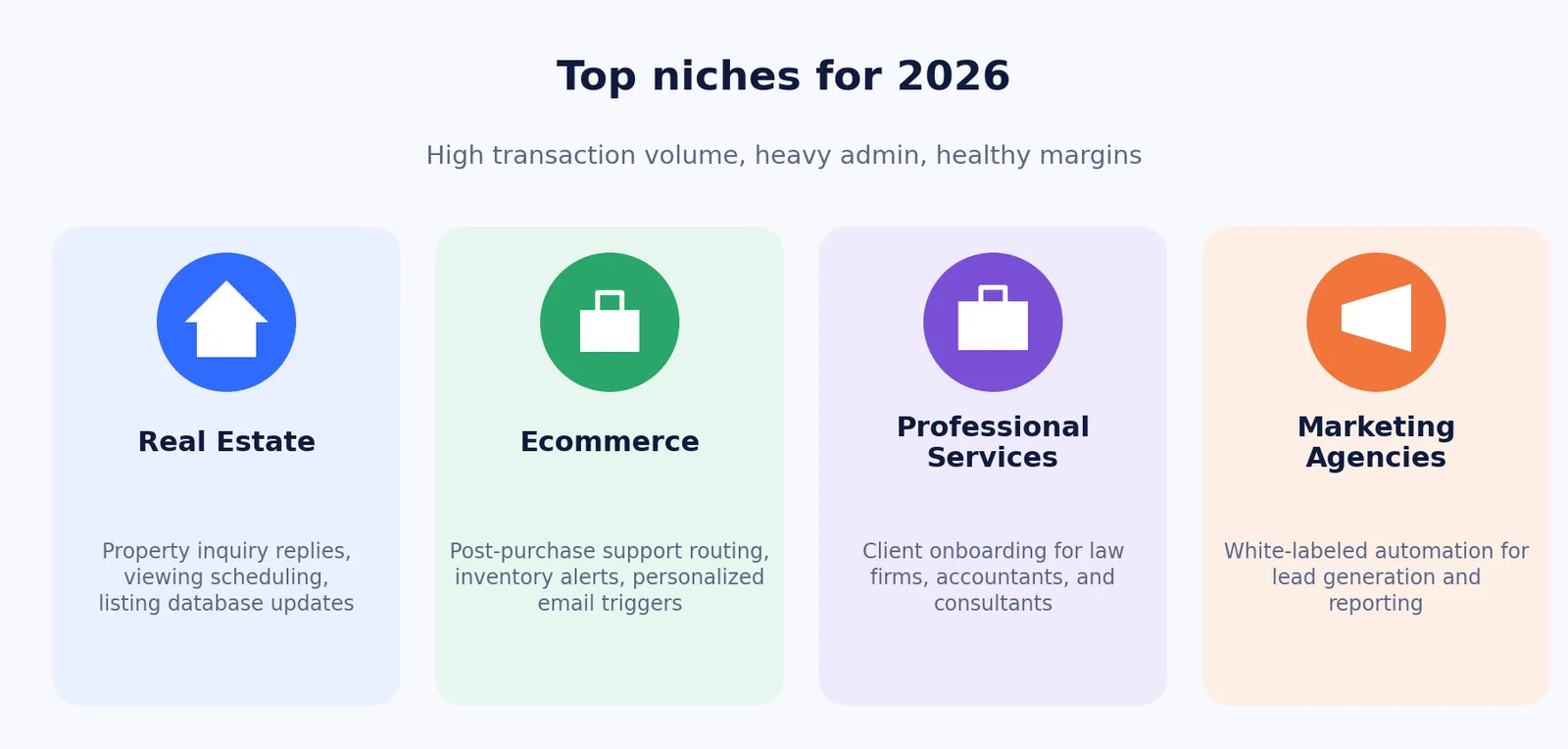
Top niches for 2026
When evaluating AI automation business ideas, look for industries with high transaction volumes, heavy administrative burdens, and healthy profit margins.
- Real Estate: Automating property inquiry responses, scheduling viewings, and updating listing databases.
- Ecommerce: Post-purchase customer service routing, inventory alert automation, and personalized email marketing triggers.
- Professional Services: Automating client onboarding for law firms, accounting practices, and consultants.
- Marketing Agencies: White-labeling your automation services to help other agencies streamline their lead generation and reporting.
A note on small businesses
Many beginners target local mom-and-pop retail shops. Be cautious here — while small businesses desperately need efficiency, they often lack the capital to afford a proper setup fee.
You’ll spend hours convincing a local bakery to spend $2,000. Instead, target established mid-market companies or B2B service providers. They understand the cost of labor and will gladly pay $5,000 to solve a concrete operational headache.
Finding clients and scaling operations
Building the tech is only half the battle. The rest is pipeline management — you need a system for getting in front of the right buyers before your runway runs out.
Where to find your first clients
Do not rely entirely on cold emails in the beginning. Your first clients will likely come from high-trust environments — start with local relationships and professional networks.
Freelance marketplaces like Upwork can provide initial traction, though you’ll face heavy price competition. The best strategy is community referrals: join niche industry groups online, and when business owners complain about manual data entry, offer a free mini-audit. Deliver massive value upfront to earn the right to pitch the larger build.
Can you run this as a side hustle, or does it need to be full-time?
Yes, you can absolutely start this as an AI side hustle. In fact, you should — keep your day job while you learn the platforms and secure your first case study.
The beauty of the agency model is asynchronous work (work you complete on your own schedule rather than live, in real time, with the client). You can build workflows on nights and weekends, and only need to transition to full-time once your monthly recurring retainers comfortably cover your baseline living expenses. This removes the desperation from your sales calls.
Where solo agencies break down (and how to plan around it)
Many guides point out the fatal flaw of the solo agency: the maintenance trap. When you have two clients, you’re building. When you have ten clients, you’re purely fixing broken API connections.
Plan for this bottleneck from day one. Charge high enough retainers to eventually hire a virtual assistant or junior operator. Standardize your builds — don’t create bespoke, customized messes for every client. Use standard templates so that when something breaks, the fix is identical across your entire portfolio.
How to start this week (step-by-step)
Stop reading theory and start building. Action creates momentum. Follow this exact sequence to launch your agency in the next seven days.
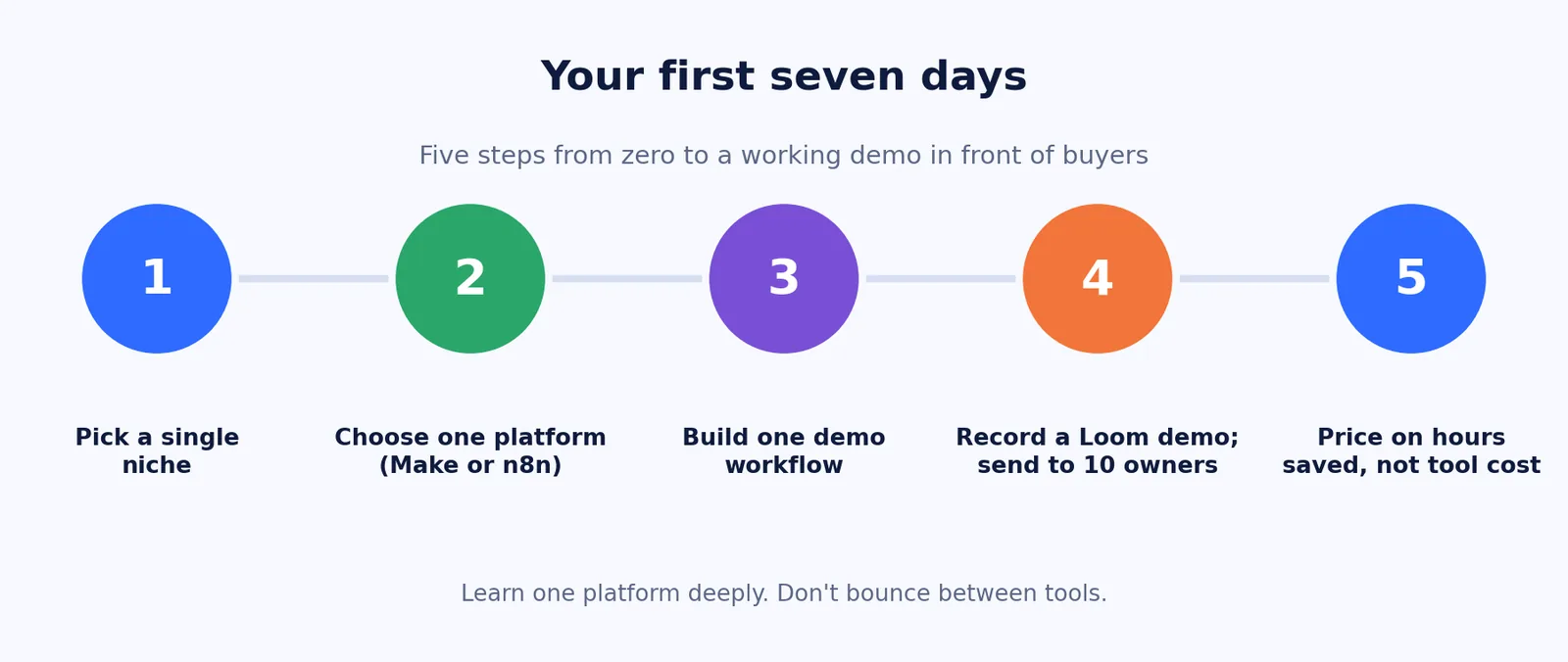
- Step 1: Pick a single niche.
- Step 2: Choose one platform — ideally Make or n8n — and learn it deeply. Do not bounce between tools.
- Step 3: Build one highly functional demo workflow for your chosen niche.
- Step 4: Record a Loom video walking through that exact demo and send it to ten business owners in that space.
- Step 5: When someone replies, price the initial setup based on the hours of labor you’re saving them, not the cost of your software subscription.
The bottom line
There’s a real, profitable business in the gap between AI adoption and AI results — most companies have the tools but not the systems to use them well, and that’s exactly what a good automation agency sells. The founders who win aren’t the ones with the fanciest tech stack; they’re the ones who pick a niche, price on value, and standardize early so the maintenance trap doesn’t swallow their calendar.
If you’re ready to start, don’t overthink the tooling. Pick one niche from the list above, build a single working demo this week, and send it to ten business owners before you second-guess the pricing.
FAQ
What is the difference between an AI agency and an AI consultant?
An agency builds the automated workflows, deploys them, and maintains them for a monthly retainer. A consultant audits a business, provides a strategic roadmap, and charges an hourly or flat advisory fee without doing the actual building.
Do I need to know how to code to start an AI agency?
No, modern platforms like Make and Zapier are visual, no-code builders. However, understanding basic API structures, webhooks, and JSON will significantly speed up your troubleshooting and allow for more complex builds.
Can I run an AI automation agency as a side hustle?
Yes. Workflow building is largely asynchronous, allowing you to execute projects on nights and weekends. Keep your day job until your recurring retainers match your living expenses.
How long does it realistically take to get the first client?
There is no reliable public benchmark for this, so we will not give you a number. Founders who prospect actively with a targeted demo video and use their existing network tend to hear back sooner than those who wait for inbound, but results vary widely.
How much should I charge for a single AI workflow?
Never charge based on software costs; price based on the value of the labor replaced. brainstudioz lists $1,500 to $5,000 for simple builds with a $500 to $2,000 monthly maintenance retainer, and more for multi-system builds. Treat that as a range from one guide, not a standard.
Was this article useful?
Thanks, that helps us decide what to write next.
Spotted a mistake? Report an error and we will fix it, with a dated correction note.