How to Sell AI Art on Etsy: A Beginner’s Guide (2026)
What Etsy allows, how to disclose AI use and how fees affect your pricing when you sell AI art.
Please read: This guide is for education only. It isn’t legal, tax, or financial advice, and it doesn’t promise any income. Etsy’s rules and fees change, and this article reflects Etsy’s own pages as of October 2, 2026. Fees are shown in U.S. dollars for U.S. sellers.
If you want to sell AI art on Etsy, the good news is that Etsy allows it. The catch is that it comes with rules, and breaking them can get your listings removed. This guide explains those rules in plain English, what kinds of art people sell, what Etsy takes from each sale, and how to make your first listing. It won’t promise you income, because nobody honestly can.
The short version
- Etsy allows AI art made from your own original prompts, but you must say in the listing that AI was used.
- Etsy does not allow you to sell AI prompt bundles. The finished art is the product.
- Etsy’s fees take a bigger bite out of cheap items, so do the math before you set a price.
Can You Sell AI Art on Etsy? The Rules in Plain English
Yes, within limits. Etsy’s Creativity Standards sort every listing into four groups: made by, designed by, handpicked by, or sourced by a seller. AI art goes under “designed by a seller,” where Etsy calls it a seller-prompted AI creation. That means art generated with AI tools from your own original prompts.
Two rules matter most. First, you must say in your listing description that AI was used. Second, you can’t sell AI prompt bundles. Etsy says prompts are part of the creative process and shouldn’t be sold apart from the finished artwork. If prompts are what you want to sell, our guide on how to sell AI prompts covers other options.
Etsy’s own examples make this clearer. It lists a fantasy scene based on a seller’s original prompt and a custom portrait of a buyer’s pet as allowed. It lists AI prompt bundles as not allowed. You can read these on the AI creations page in the Seller Handbook, and TechCrunch covered the 2024 rollout.
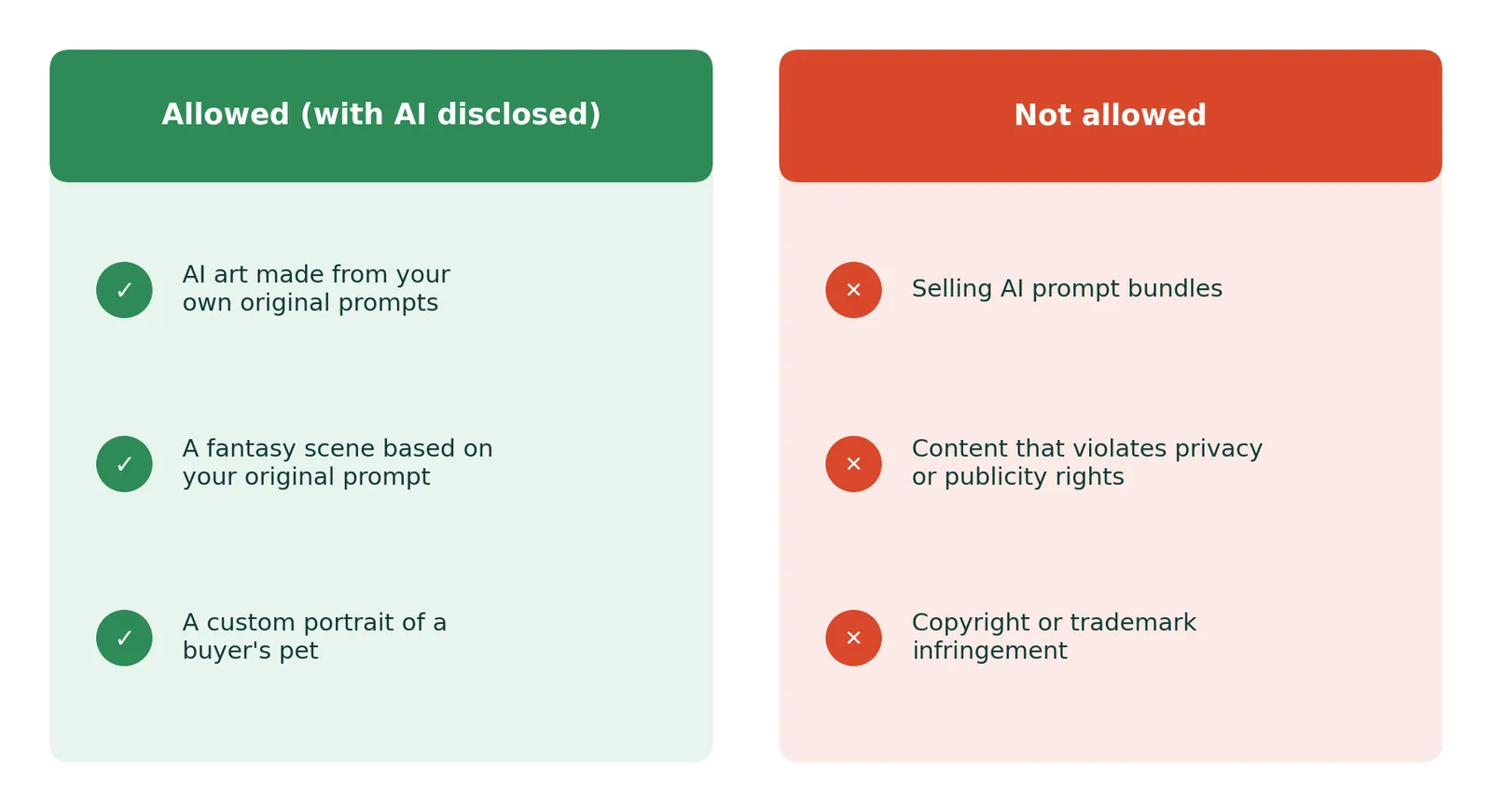
A few other rules apply too. Etsy says AI-made images of nudity or sexual content must follow its Prohibited Items Policy. It also bans content that violates other people’s privacy, publicity, or personal rights, and its Intellectual Property Policy covers copyright and trademark.
Etsy can remove listings that break its policies, and you still owe the fees. The Creativity Standards page was last updated on June 10, 2025, and Etsy has said it will keep reviewing its AI approach. So read the current page before you list.
What Kinds of AI Art Can You Sell?
There’s no official list of best-sellers, so treat these as starting ideas, not promises. If you’re hunting for the best AI art to sell, the answer is usually a clear product for a clear buyer.
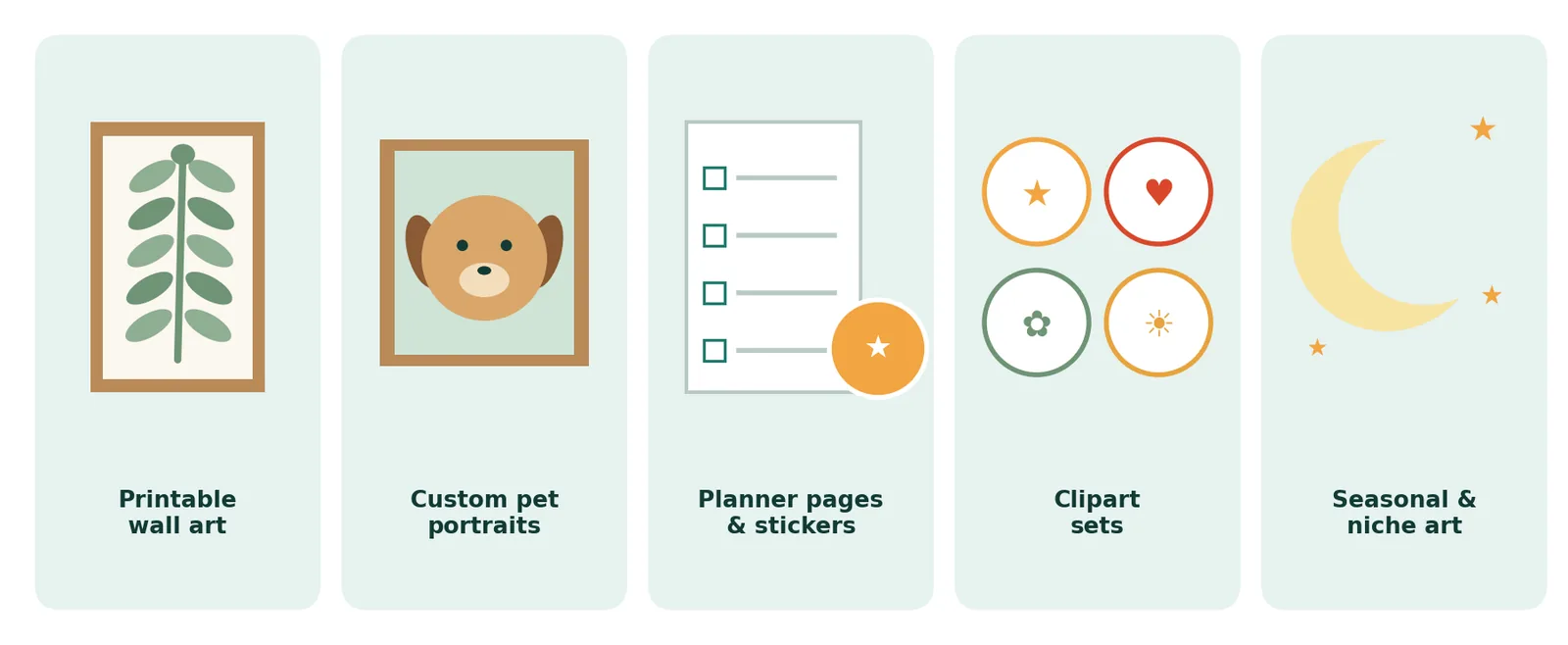
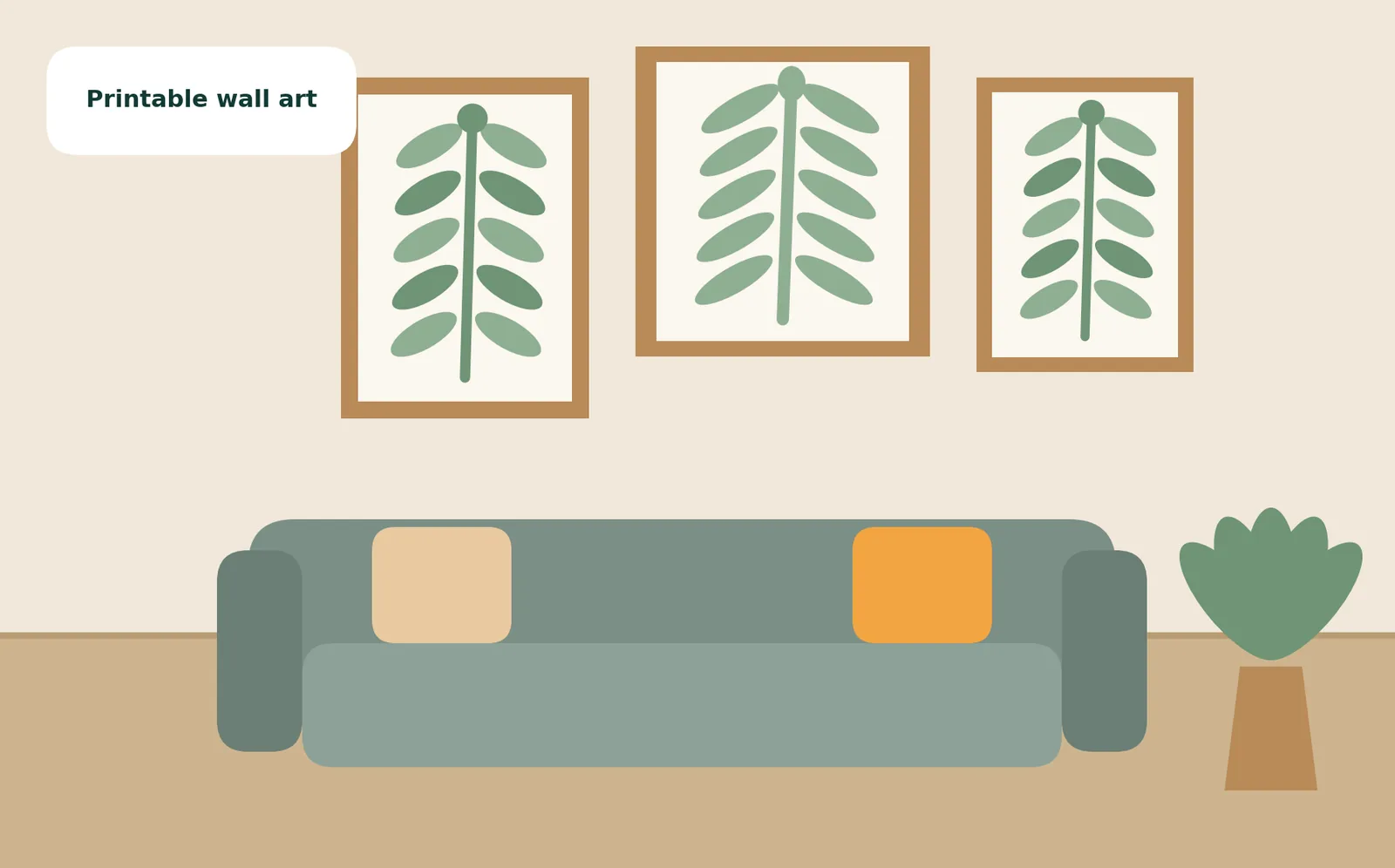
- Printable wall art: for example, a sage-green botanical print sized for a living room gallery wall.
- Custom pet portraits: the buyer sends a photo and you create a stylized portrait. Etsy names this as an allowed AI item.
- Digital planner pages and stickers: a monthly spread in one color theme.
- Clipart sets: icons or illustrations for teachers or small business owners. State clearly how buyers may use them.
- Seasonal or niche art: nursery prints, wedding signs, or hobby illustrations.
How do you check demand? Search your idea on Etsy and look at what comes up. Note the prices, the photos, and how many reviews the top listings have. Then ask what you could offer that’s different, such as a narrower style or a better set.
Keep one thing in mind. Many sellers can generate similar images, so presentation and a clear niche usually matter more than the AI tool you pick. If you also like making video, our guide to starting a faceless YouTube channel with AI covers a related side project, and this guide to automating work with AI shows how to save time on repetitive steps.
Digital Downloads vs. Print-on-Demand
You have two main ways to sell AI art. You can sell a digital file, or you can sell a physical item through print-on-demand. Etsy allows both under “designed by a seller.”
| Digital downloads | Print-on-demand (POD) | |
|---|---|---|
| What you sell | A digital file the buyer prints or views | A physical item (poster, mug, shirt) made by a partner after each order |
| Etsy category | Designed by a seller (your original design as a download, or a seller-prompted AI creation) | Designed by a seller (your original design produced by a production partner) |
| What you must disclose | That AI was used, in the listing description | That AI was used, plus your production partner and an accurate shipping origin |
| Costs beyond Etsy fees | Your tools and your time | The partner’s production cost for each item |
| A good fit if | You want to test designs with less to manage | You want to offer physical products without holding stock |
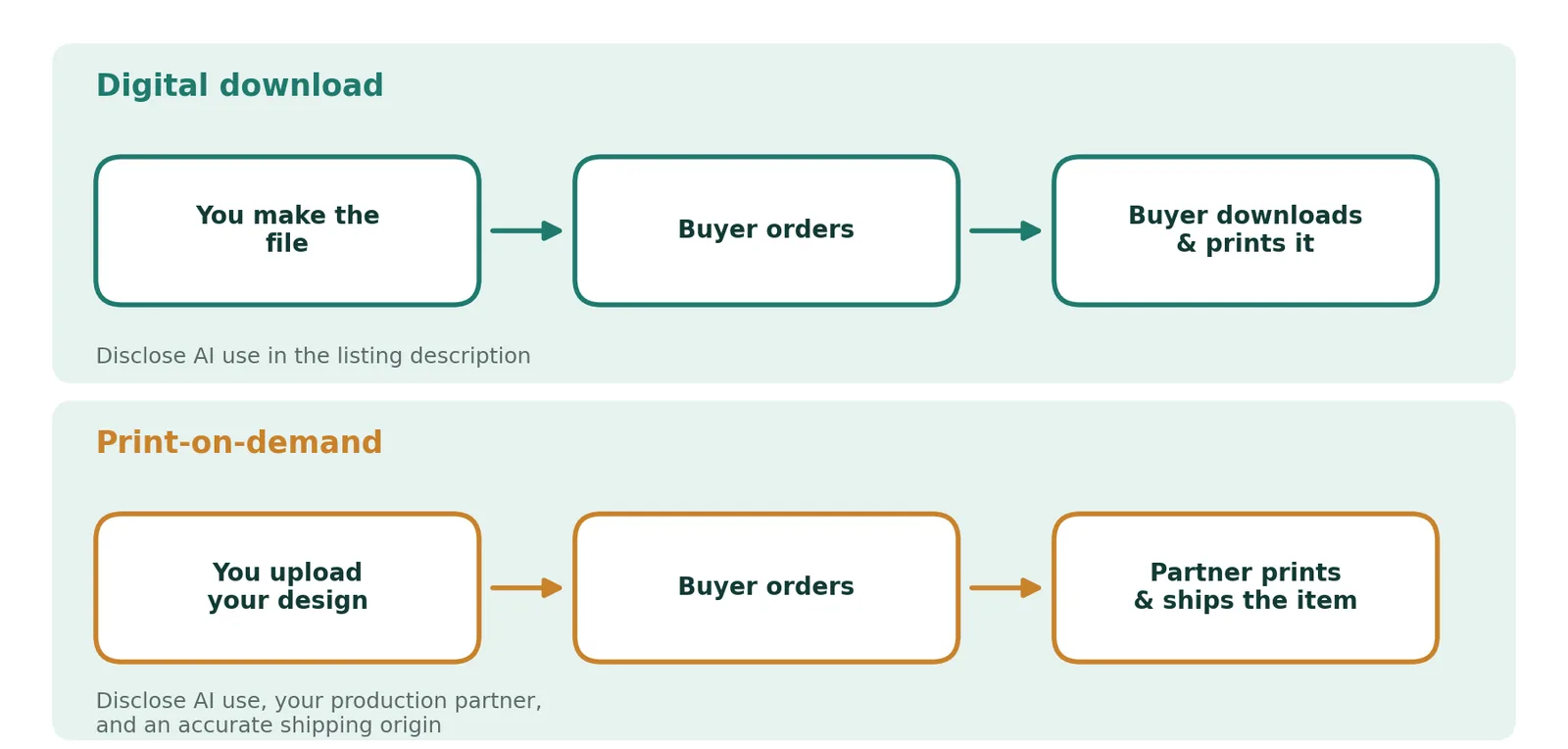
With print-on-demand, a production partner makes and ships the item after an order comes in. A company such as Printify is one example. Etsy requires you to disclose your production partner and give accurate information about where the item ships from. That’s the same Creativity Standards page as above.
Many beginners start with digital downloads because there’s no product to make or ship. It’s a reasonable first test, but it’s your call. If you try print-on-demand later, check the partner’s production costs on top of Etsy’s fees.
What You Need Before You Start
- An AI image generator whose terms let you sell the images. Terms differ by tool and plan. Midjourney’s terms, for example, say you own your creations as far as the law allows, and they require a Pro or Mega plan for companies earning over $1 million a year.
- An Etsy seller account. Etsy says a one-time set-up fee may apply. If it does, you’ll see the amount when you open your shop.
- An image editor or mockup tool, such as Canva or Photoshop, for edits, resizing, and showing your art in a room or frame.
- A simple filing system, so you can find your files and keep notes on your prompts and edits.
Notice that some of these cost money before your first sale. Add them up so you know your starting costs.
Step-by-Step: Make Your First Listing
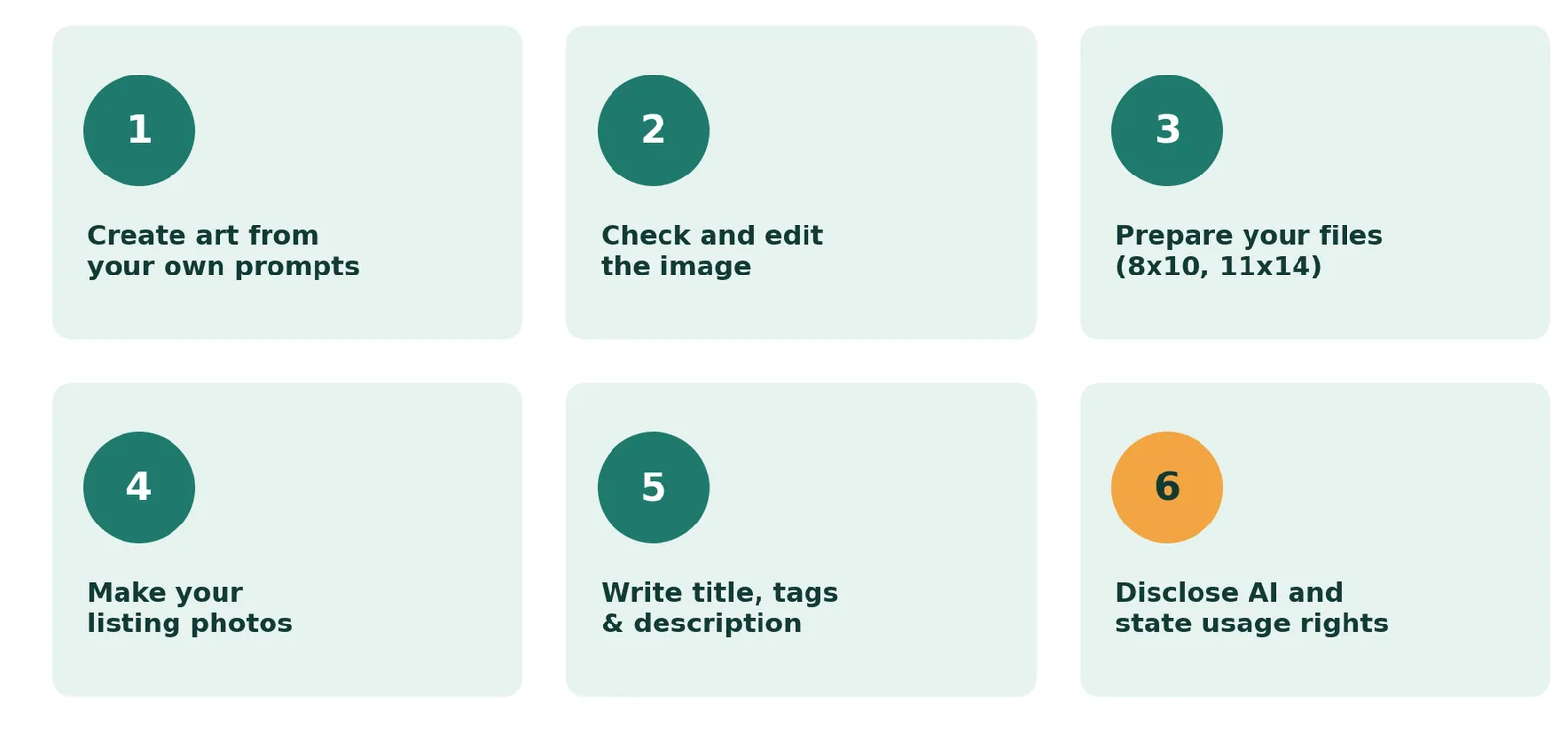
- Create your art from your own prompts. Etsy’s rule is based on your original prompts, so don’t copy someone else’s. Try a few variations and pick the strongest one.
- Check and edit the image. Look closely for odd details, like warped shapes or garbled text. Fix them or choose another version.
- Prepare your files. Decide which print sizes you’ll offer, such as 8×10 or 11×14. Make sure the file is large enough for your biggest size, and enlarge it if it isn’t.
- Make your listing photos. Show the art in a frame or room scene. Read Etsy’s Listing Image Requirements first.
- Write your title, tags, and description. Put the main phrase early in the title. An example title is “Sage Green Botanical Wall Art, Printable Living Room Decor.”
- Disclose AI and state the usage rights. Say AI was used, in your own words. For example: “Created with AI image tools from my own original prompts.” Adjust it to match what you actually did, and say whether buyers get personal use only or a commercial license.
What Etsy Takes From Each Sale
Before you set a price, learn the Etsy fees. Here is what Etsy’s Fees & Payments Policy lists. A one-time set-up fee may apply when you open a shop. Each listing costs $0.20 and lasts four months, and a multi-quantity listing renews for another $0.20 after each sale. Etsy also takes a 6.5% transaction fee on the item price plus shipping.
On top of that, Etsy Payments charges a processing fee that depends on where your bank account is. For U.S. sellers, the Etsy Payments Policy lists 3% plus $0.25 per order. Sellers elsewhere pay different rates.
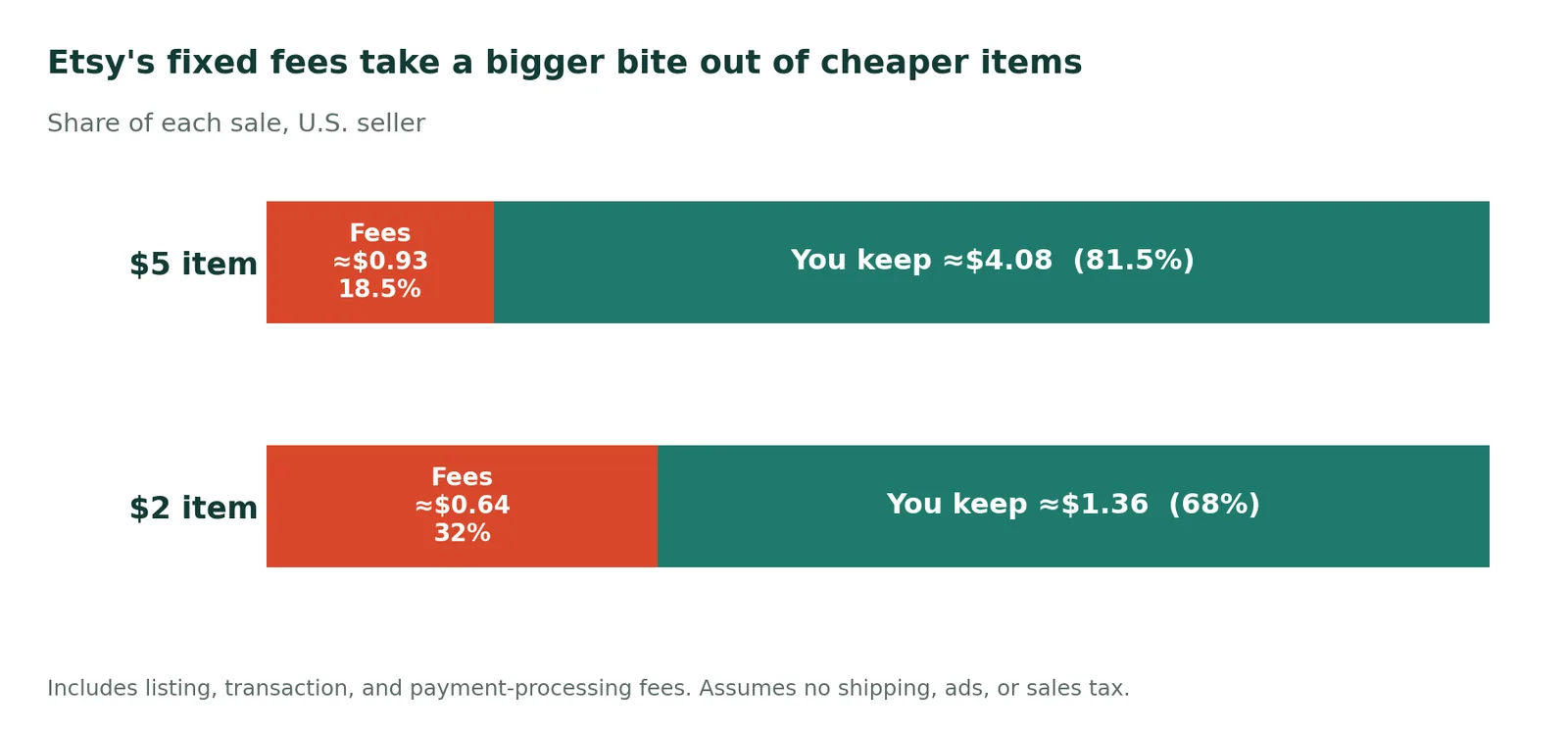
Here is a worked example. Say you sell a $5 digital download as a U.S. seller, with no shipping, no ads, and no sales tax. The fees are $0.20 (listing), $0.33 (transaction), and $0.40 (processing). That’s about $0.93 in total, so you keep about $4.08, or roughly 81.5%.
Now try a $2 item. The same fees come to about $0.64, so you keep about $1.36. The fixed pieces hurt cheap items most. That’s one reason to think about bundling several related designs into a single listing.
One more fee to know about is Offsite Ads. If a buyer clicks an ad that Etsy runs and orders from your shop within 30 days, you pay a fee on that order. Etsy lists 15% for shops under $10,000 in sales over the past year, and you can opt out while you’re under that line. On a $5 order, 15% is $0.75, which would cut what you keep to about $3.33.
To price your work, look at similar listings, work out your own costs per sale, and test. Don’t copy a price without checking the math.
How to Get Found on Etsy
Good Etsy SEO starts with how Etsy search works. According to Etsy’s Seller Handbook, search looks at your title, tags, attributes, description, first photo, reviews, and more. It’s not just one thing.
Etsy’s advice on tags is simple. Use all 13 tags, make them multi-word phrases of up to 20 characters, and make each one as unique as you can. For the botanical print above, you could use phrases like “botanical wall art,” “sage green decor,” “printable wall art,” and “living room print.”
Your first photo matters because it’s what shoppers see in search results. Reviews matter too, so answer messages quickly and deliver exactly what you promised. Finally, be patient. Nobody can tell you how long a new shop takes to get its first sale.
Risks and Realistic Expectations
Selling AI art can be a fun side project, but it isn’t guaranteed income. Here are the risks to weigh:
- Income isn’t guaranteed. You pay costs before you earn, and results depend on your niche, your listings, and your time.
- Rules can change. Etsy has said it will keep monitoring this area and may reevaluate its policies.
- Listings can be removed. If a listing breaks the rules, Etsy can take it down and you still owe the fees.
- Some buyers may object to AI art. Etsy itself says there are ongoing conversations about how AI models are trained, plus concerns about bias and environmental impact.
- Protection is limited. AI-only images may not get copyright protection, so copying can be hard to stop. See the FAQ below.
- You’re responsible for your taxes. Etsy’s policy says you’re responsible for taxes on your sales, and it may send U.S. sellers a Form 1099-K. A tax professional can explain what applies to you.
A Quick Checklist Before You Publish
- Does the description say AI was used?
- Did you make the art from your own prompts, and are you selling the art, not the prompts?
- Does it avoid copyrighted characters and real people’s likenesses?
- If a production partner makes it, have you disclosed the partner and the shipping origin?
- Have you saved your prompts, edits, and your AI tool’s terms (with the date) in case you need them later?
Frequently Asked Questions
Is selling AI art on Etsy allowed?
Yes. Etsy allows AI art made from your original prompts, under “designed by a seller.” You must disclose the AI use in your listing description. Selling AI prompt bundles is not allowed.
Do I have to say my art is AI-made?
Yes. Etsy’s Creativity Standards say sellers must disclose in the listing description when an item is created with AI. Etsy can remove listings that don’t follow its policies.
What AI art sells best?
Nobody can say for sure. Printable wall art, pet portraits, planner pages, and clipart are common starting points. The safest way to judge a niche is to study the listings already there and look for a gap.
Can I copyright AI art?
Maybe, but only in part. The U.S. Copyright Office said in January 2025 that AI outputs can be protected only where a human author determined sufficient expressive elements. It also said that prompts alone aren’t enough. Your own creative edits or arrangement may count, but it’s decided case by case. The Office’s AI page has the full report, and our guide on copyright for AI art goes deeper. For your own business, ask an IP lawyer.
How much can beginners make?
Nobody can honestly promise a number. For scale, ten $5 sales would leave about $40 after Etsy’s fees, before your tool costs and taxes. Track your real costs and sales for a few months before you count on any income.
Related reading: how to sell AI prompts.
Bottom Line
You can sell AI art on Etsy if you use your own prompts, disclose the AI, and sell the art rather than the prompts. Count your costs, expect a slow start, and don’t rely on income you haven’t earned yet. A small, honest first batch of listings will teach you more than any guide.
Your next step: before you make your first listing, read the “designed by a seller” section of Etsy’s Creativity Standards.
Was this article useful?
Thanks, that helps us decide what to write next.
Spotted a mistake? Report an error and we will fix it, with a dated correction note.