AI Investing Apps for Beginners: How They Work (2026)
How AI investing apps work, what they cost and how beginners can use them safely.
This is not financial advice. This article is for education only. It does not recommend any app or investment, and it is not tax or legal advice. Investing involves risk, including the loss of money. This guide covers apps and rules in the United States. Talk to a licensed professional about your own situation.
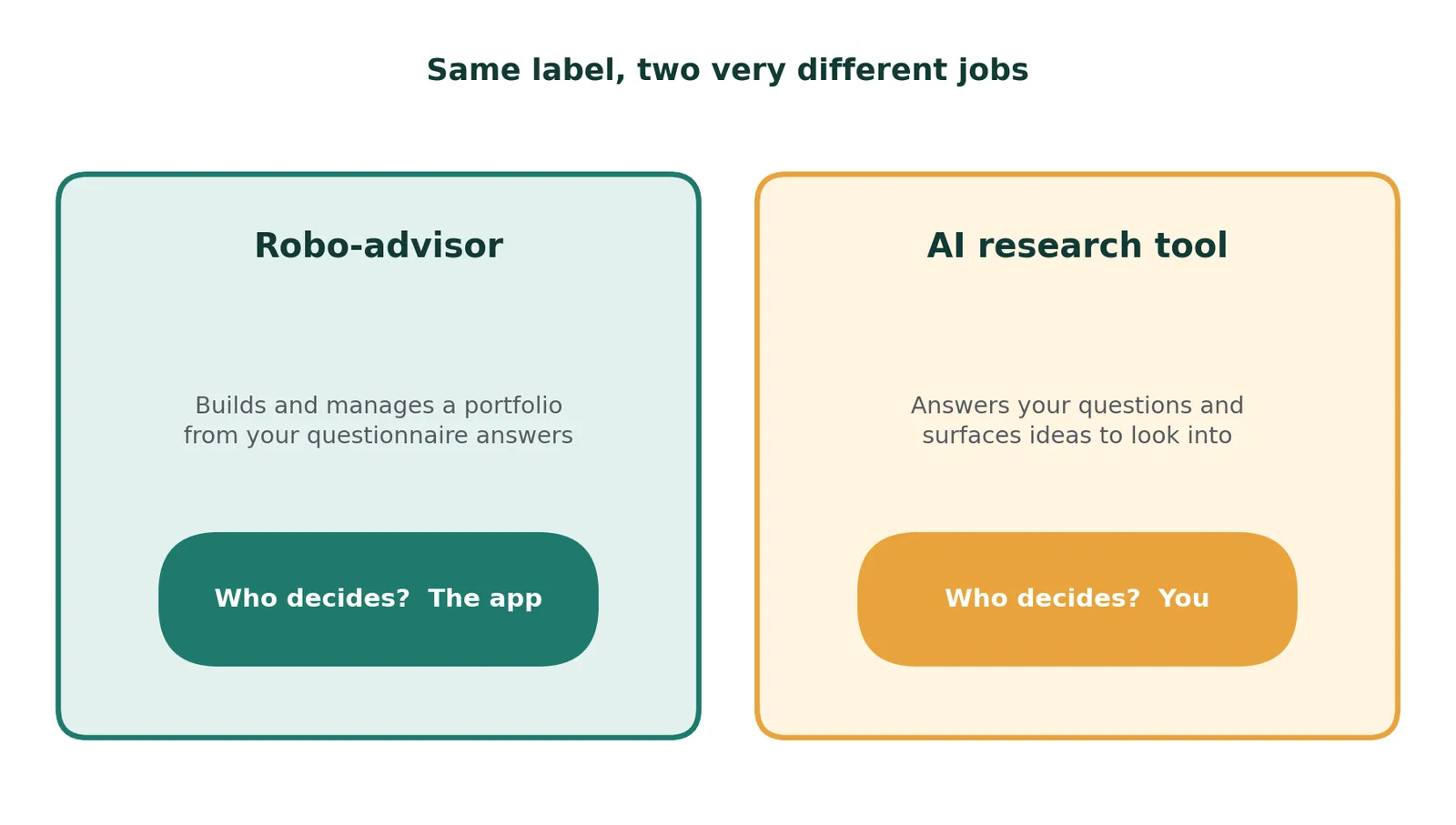
AI investing apps are everywhere, but the label can mean two very different things. Some are robo-advisors that build and manage a portfolio for you. Others are chatbots and research tools that answer questions but leave every decision to you. This guide explains how each type works, what it costs, and where beginners get into trouble.
We don’t rank apps here. Any app we name is an example, not an endorsement.
The short version
- Robo-advisors choose and manage a mix of investments for you, based on your answers to a questionnaire.
- AI research tools help you look things up. You still make the buying and selling choices.
- No app can promise returns. Be extra careful with any app that does.
Two Kinds of AI Investing Apps
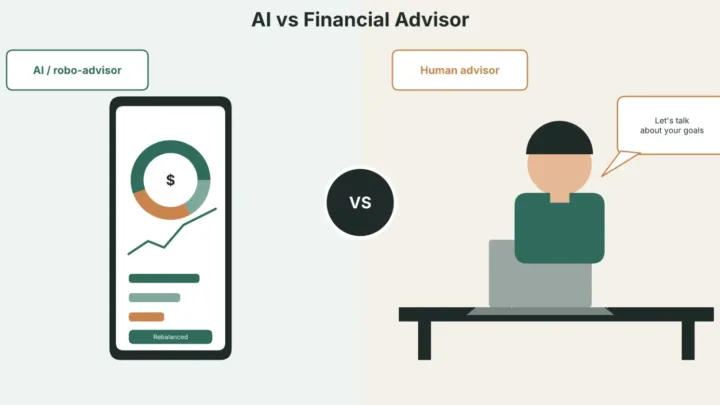
Think of the two types as two different jobs. A robo-advisor does the investing work for you. The SEC describes a robo-adviser as an automated program that asks about your goals and risk tolerance, then builds and manages a portfolio for you.
Betterment, Wealthfront, and Schwab Intelligent Portfolios are well-known examples. The SEC says robo-advisers are typically registered investment advisers, and many use ETFs. An ETF is a fund that holds many investments in one package and trades like a stock.
Micro-investing apps sit close to this model. Acorns says its Round-Ups feature rounds each linked purchase up to the next dollar and invests the difference. So a $4.30 coffee would send 70 cents to your portfolio.
An AI research tool does a different job. Robinhood’s Cortex is one example. Robinhood describes it as a chat assistant for Gold subscribers that can help with investment research and portfolio questions. It can also carry out certain trades when you give it a text or voice command, and Robinhood tells users to read its disclosure on the tool’s limits and risks.
Why does this matter? The word “AI” on an app store page doesn’t tell you which job the app does. Before you sign up, ask one question: does this app choose investments for me, or does it only answer questions?
How Robo-Advisors Work
Most robo-advisors follow the same steps. You answer a questionnaire about your goals, your timeline, and how much risk you can handle. The app builds a portfolio from your answers and manages it for you.
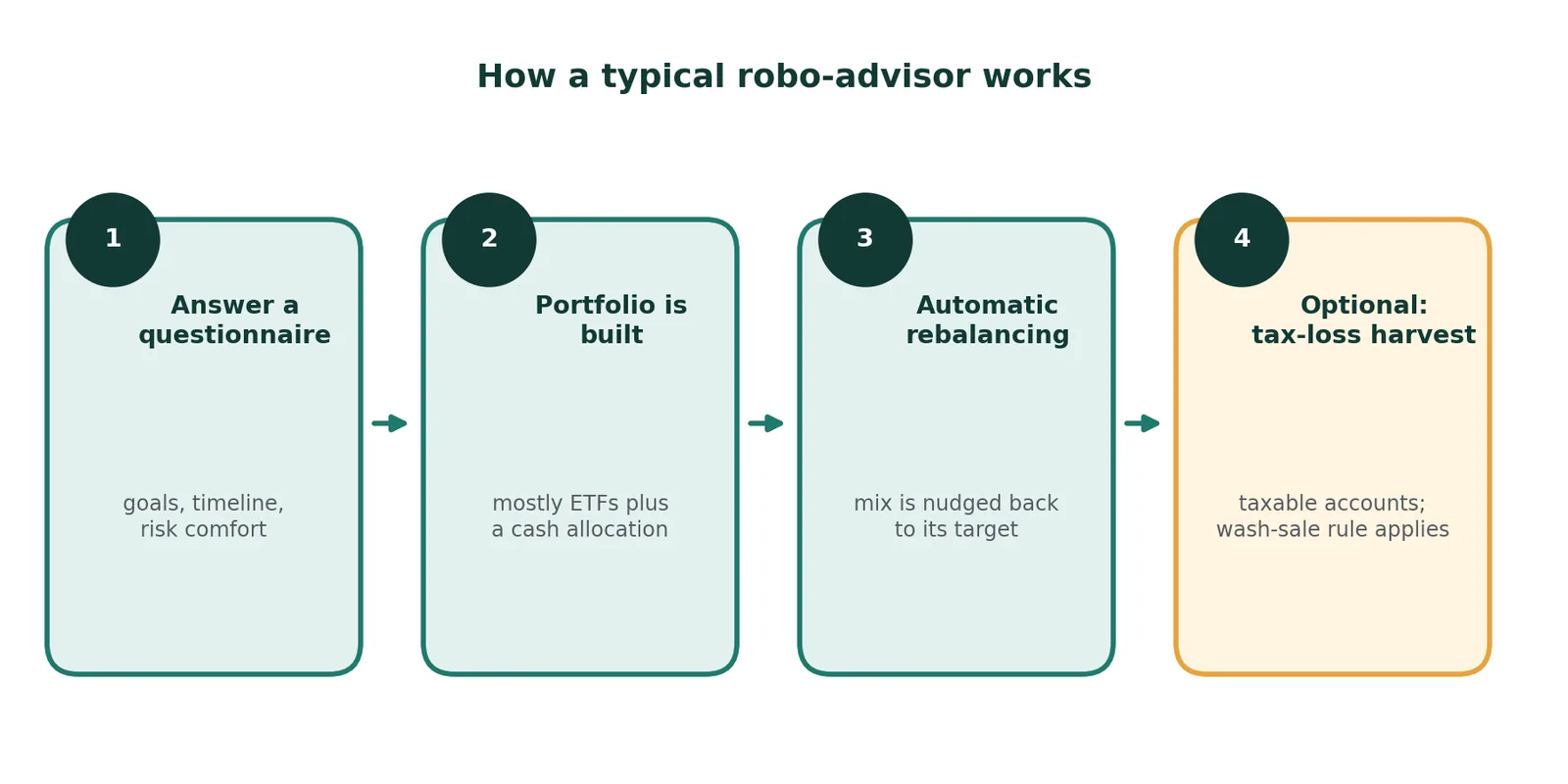
Schwab gives a clear picture of this on its own site. It says its portfolios are built from ETFs plus a cash allocation, based on your goals, risk tolerance, and timeline. Many apps also advertise automatic rebalancing, which means moving your mix back toward its target after the market pushes it off course.
Some apps also offer tax-loss harvesting in taxable accounts. The app sells an investment that has dropped in value. That loss may help offset taxable gains elsewhere.
There is a catch called the wash-sale rule. If you buy a substantially identical investment within 30 days before or after the sale, the IRS does not let you deduct the loss. IRS Publication 550 has the details, and a tax professional can tell you how it applies to you.
Automated doesn’t always mean smart. How much of an app’s work is true AI, and how much is simple rules, varies from app to app. So ask what the “AI” actually does. The SEC also lists the amount of human help you want as a key question when you choose one.
How AI Research and Trading Tools Work
AI research tools work more like a smart search box than a money manager. You ask a question, such as what a company does or what a fund holds, and the tool writes an answer. Robinhood says Cortex can help with investment research, portfolio questions, and finding your way around the app.
These tools can be wrong. In a joint alert, the SEC, FINRA, and state regulators warned that AI-generated information may rest on inaccurate, incomplete, or outdated data. They also said it can be made up entirely.
A better habit is to treat each answer as a tip, not a fact. Say a chatbot tells you a company’s sales are growing fast. You can check that in the company’s own filings using the SEC’s EDGAR database.
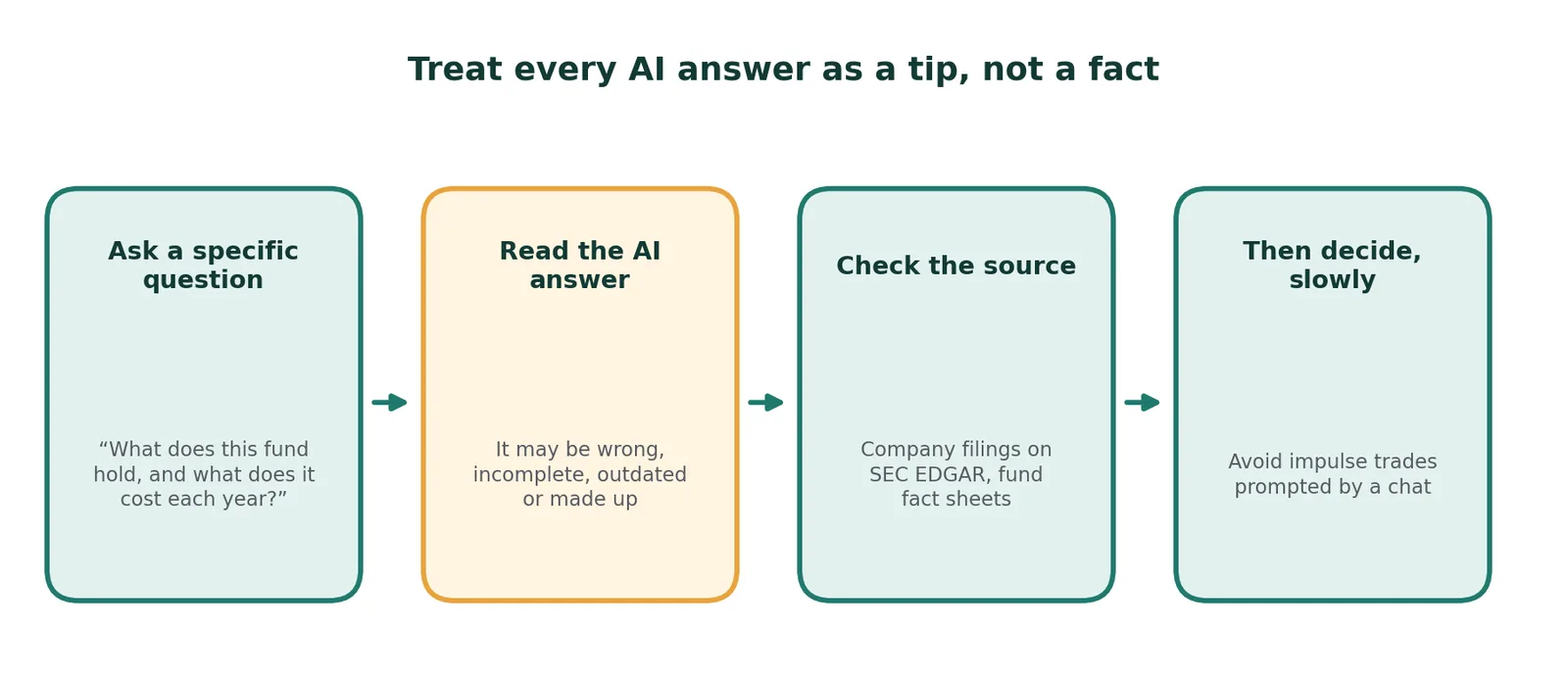
The questions you ask matter too. “Which ETF is best under $100?” is a weak one, because a share price says little about whether a fund fits you. “What does this fund hold, and what does it cost each year?” is much better. The same alert warns that chatbot conversations can push people toward impulsive choices, so slow down.
What AI Investing Apps Can and Can’t Do
| Robo-advisors | AI research tools | |
|---|---|---|
| Main job | Builds and manages a portfolio for you | Answers questions and surfaces ideas |
| Who makes the buy or sell call | The app, based on your questionnaire | You (some tools can place trades on your command) |
| Good for | Hands-off, long-term investing | Learning and research |
| Can’t do | Promise returns or shield you from losses | Predict prices reliably or guarantee returns |
| Watch for | Fees, cash allocations, limited human help | Wrong or outdated answers, impulse trades |
Neither type can promise results. Regulators call claims of guaranteed high returns with little or no risk a classic sign of fraud. They also say to be wary of AI guarantees even from registered firms.
The same goes for charts showing how a strategy would have done in the past. Past results aren’t a promise about the future. The SEC has a bulletin on performance claims if you want to learn how to read them.
What Do AI Investing Apps Cost?
Fees look small, but they add up over time. The SEC shows this with a hypothetical $100,000 that grows 4% a year for 20 years.
With a 0.25% yearly fee, the account ends near $208,000. With a 1.00% fee, it ends near $179,000. These are SEC examples, not forecasts of what any app will earn.

Here are the costs to look for:
- Advisory fee: a yearly percentage of your balance, or a flat monthly fee, paid to the app.
- Fund costs: each fund charges its own expense ratio. A 0.25% expense ratio means about $25 a year for every $10,000 you hold.
- Other charges: account minimums, transfer-out fees, and any cash that sits uninvested.
Real prices show the range. Betterment’s help page lists an advisory fee of 0.25% a year or $5 a month, depending on your balance and recurring deposits. It also lists a $75 fee to transfer an account out to another company.
Schwab Intelligent Portfolios shows why “free” deserves a second look. Schwab says it charges no advisory fee for the service. It also says its portfolios include a cash allocation held at Schwab Bank, which earns income on those deposits, and that some cash options outside the program pay a higher yield.
Prices change often. The figures above were listed on each company’s site in October 2026, so confirm current numbers before you sign up. The free Fund Analyzer on Investor.gov can help you compare fund costs.
How Safe Is Your Money in an AI Investing App?
Safety comes from two separate checks. First, check that the firm is registered. The SEC says robo-advisers are typically registered with the SEC or a state regulator, and you can look up any firm for free with Investor.gov’s investment professional search tool.
Second, check where your money is held. SIPC is a nonprofit that protects customers if a member brokerage firm fails. SIPC’s own brochure says the limit is $500,000 per customer, including up to $250,000 for cash.
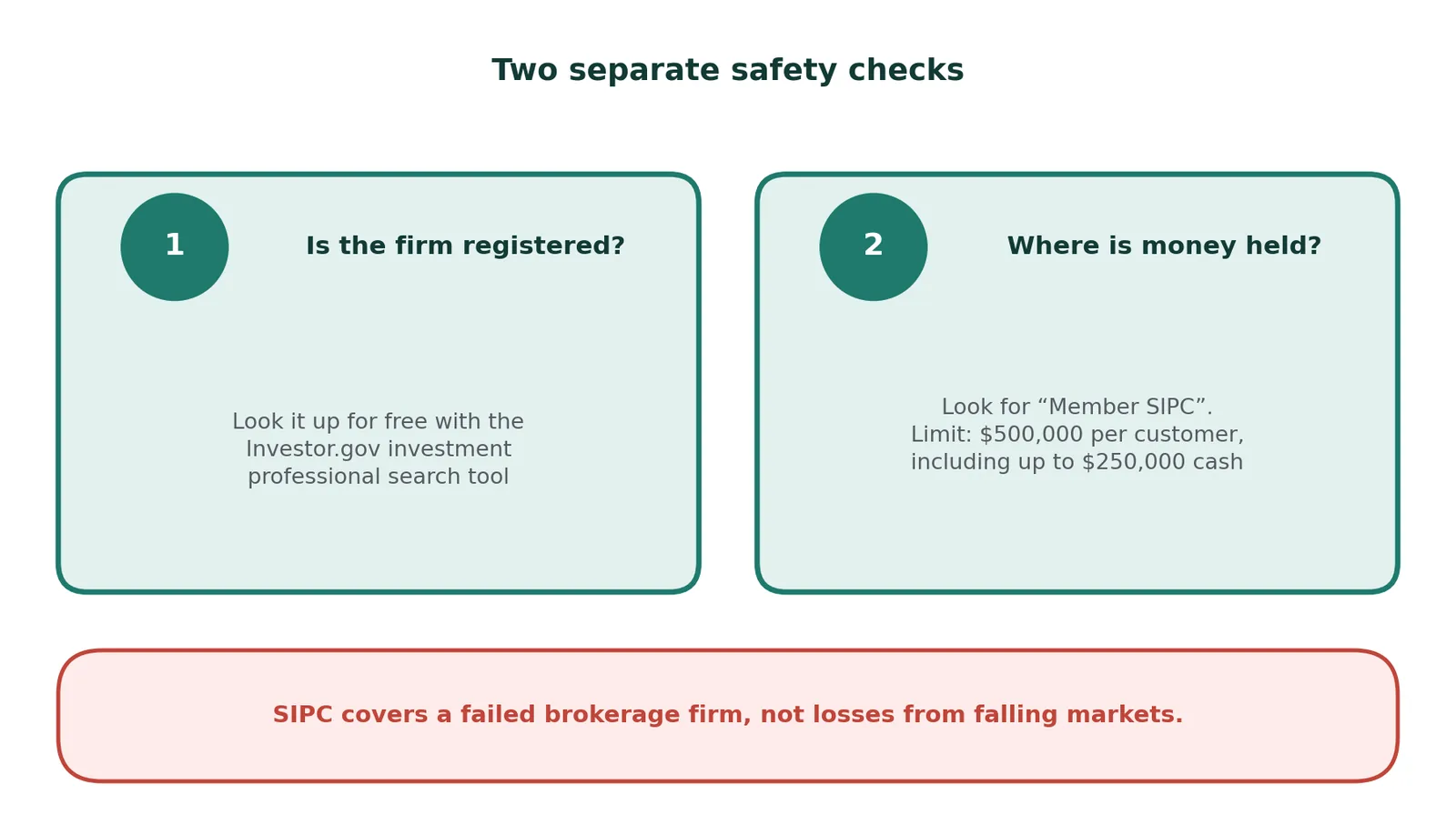
SIPC does not cover market losses. If your investments drop in value, SIPC will not make up the difference. Ask the app which brokerage holds your account, then look for “Member SIPC” or check the member list on SIPC’s website.
Risks and Scams to Watch For
Every investment can lose money, including funds picked by an AI. Imagine putting in $5,000 and watching it fall to $4,000 in a rough market. Would you stay calm or sell in a panic? If you’re not sure, work out your risk tolerance before you invest.
Scammers love the AI label. The joint regulator alert describes fake platforms that claim a trading system “can’t lose.” It also warns about deepfake audio and video, including cloned voices that pose as a relative asking for money.
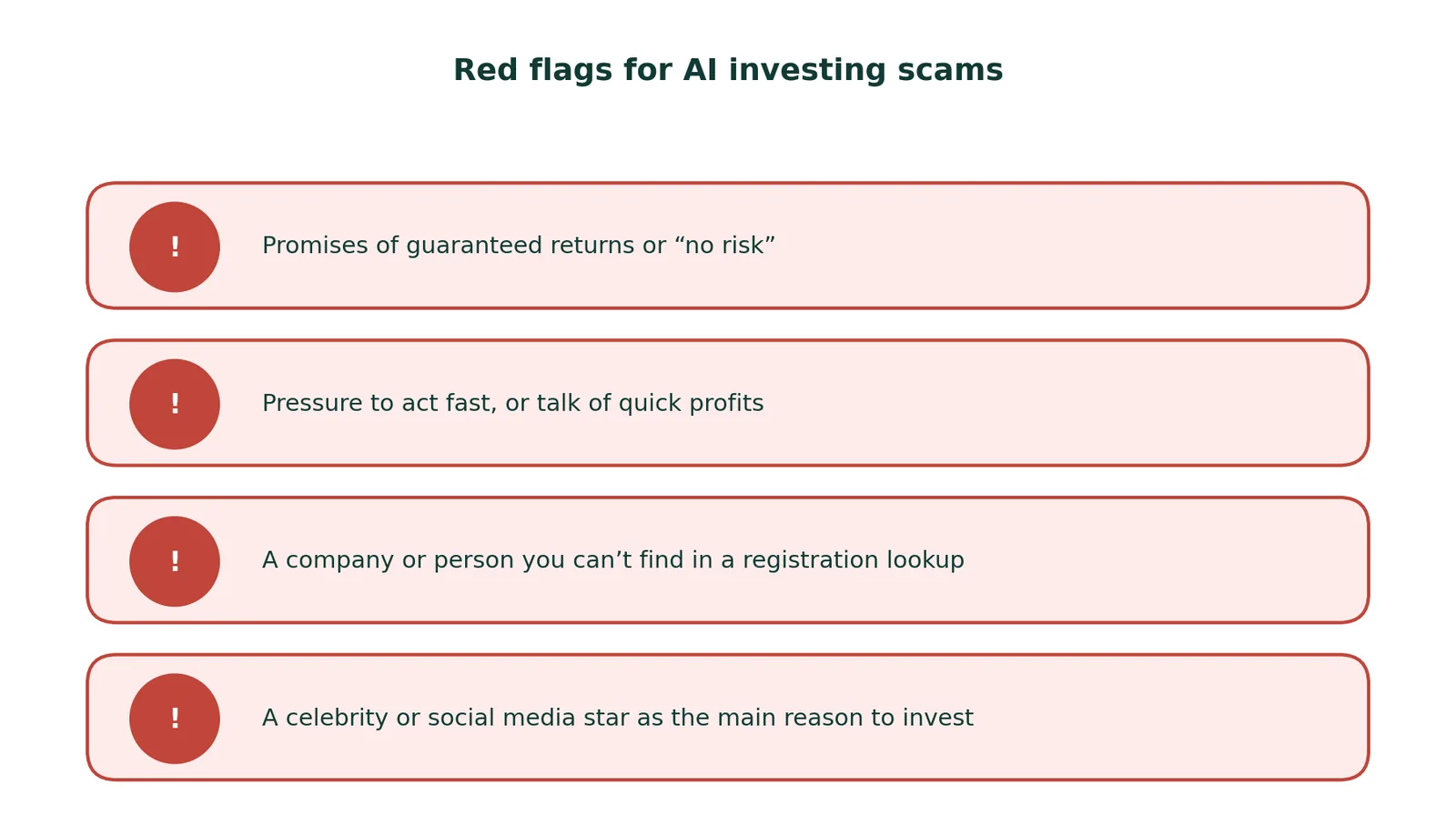
Learn the common red flags for AI investing scams:
- Promises of guaranteed returns or “no risk.”
- Pressure to act fast, or talk of quick profits.
- A company or person you can’t find in a registration lookup.
- A celebrity or social media star as the main reason to invest.
Also ask how the app makes money. As the Schwab example shows, a service with no advisory fee can still earn income in other ways. And because these apps link to your bank accounts, read what data they collect and how they protect it.
Questions to Ask Before You Open an Account
Use these questions as a starting point. The answers are yours to decide.
- What job do I want done? Hands-off investing, or help with research?
- Is the firm registered? Look it up on Investor.gov and check for “Member SIPC.”
- What will I pay each year? Add the advisory fee, the fund costs, and any cash allocation or transfer fees.
- How would I feel if my balance fell by a fifth? The SEC’s risk tolerance guide can help you think it through.
- Am I double-checking AI answers? Compare them with company filings or a registered professional.
- Does anything sound too good to be true? If so, stop and verify before you send money.
If you pick your own investments, spreading your money across many holdings can help limit the damage when one falls. Investor.gov explains how diversification works.
Frequently Asked Questions
Are AI investing apps safe?
Safety has two parts. Check that the firm is registered and that your money sits at a SIPC-member brokerage. Even then, your investments can lose value, because SIPC covers a failed firm, not market losses.
Can AI predict the stock market?
You shouldn’t count on it. Regulators advise caution about using AI-generated information to predict price changes, because it can be inaccurate, incomplete, or made up. An AI can summarize data quickly, but a summary is not a forecast.
Do AI investing apps really work?
It depends on what you mean by “work.” A robo-advisor can do what the SEC describes: gather your goals, build a portfolio, and manage it. Whether that portfolio grows depends on markets, fees, and your own choices. AI research tools can save time, but their answers still need checking.
How much do AI investing apps cost?
Costs vary. Betterment lists 0.25% a year or $5 a month, while Schwab lists no advisory fee but includes a cash allocation. Fund costs come on top, so check each company’s pricing page for current numbers.
How can I spot an AI investing scam?
Watch for guarantees, pressure to act fast, and firms you can’t find in a registration lookup. Regulators say claims of high guaranteed returns with little or no risk are classic signs of fraud. If something feels off, you can report it to the SEC, FINRA, or your state regulator.
Bottom Line
AI investing apps come in two main types: robo-advisors that manage a portfolio, and research tools that answer questions. Neither can promise returns, and both come with costs and risks you can check ahead of time. Take your time, and treat every AI answer as a starting point.
Your next step: before you open any account, look up the company with the free Investor.gov background check tool.
Related Reading
- Can AI Manage Your Money? What It Can and Can’t Do: what AI can and can’t do with your money.
- AI in Personal Finance: The Complete 2026 US Guide: the full guide to AI in personal finance.
- 11 Best AI Budgeting Apps to Save Money in 2026: start with budgeting before you invest.
Was this article useful?
Thanks, that helps us decide what to write next.
Spotted a mistake? Report an error and we will fix it, with a dated correction note.
Disclaimer. This article is general information, not financial, tax, or investment advice. Figures describe specific cases at specific dates. Talk to a licensed professional before acting on anything here. Full disclaimer.