How to Use AI to Pay Off Debt Faster (Beginner Guide)
How to use AI to compare snowball and avalanche payoff plans without sharing sensitive account details.

Not medical, legal, or financial advice. This article is for general education. If your debt feels unmanageable, a nonprofit credit counselor can help — see the resource near the end of this guide.
Paying off debt is rarely hard because of the math. It’s hard because building a plan takes time and sticking with it takes even more. Using AI to pay off debt faster works well for exactly this problem: comparing payoff strategies, running “what if I paid $50 more a month” scenarios, and turning a messy list of balances into a clear timeline. What it can’t do is move money for you, pull your real account data, or replace a certified counselor if things have gotten more serious than a straightforward payoff plan.
Here’s how to put AI to work on this safely, without handing account numbers to a chatbot.

What AI Can (and Can’t) Do Here
It can compare payoff methods, calculate the interest saved under different scenarios, and explain the trade-offs without the jargon — things a spreadsheet could technically do too, if you felt like building the formulas yourself. What it won’t do: pull your real balances from your accounts, guarantee a lender agrees to anything, or stand in for legal or credit-counseling advice if you’re facing collections or weighing bankruptcy. AI can also get arithmetic wrong, so check any totals or payoff dates it gives you against your lender statements or a simple loan calculator before you act on them.
Safety First: What Not to Share
Before typing anything into an AI chat window:
- Skip full account numbers, card numbers, and your Social Security number entirely.
- Stick to balances and interest rates. “$3,200 at 19.9% APR” is fine; the card number underneath it is not.
- Be wary of any tool asking you to link your bank account directly to a chatbot-style interface, unless it’s a regulated, reputable financial app rather than a general-purpose AI chat.
Step 1 — List Your Debts, Balances, and Rates
Gather this for everything you’re carrying:
| Debt | Balance | Interest Rate (APR) | Minimum Payment |
|---|---|---|---|
| Example: Credit Card A | $3,200 | 19.9% | $75 |
| Example: Car Loan | $9,500 | 4.5% | $280 |
| Example: Student Loan | $17,000 | 6.8% | $150 |
No account numbers needed — just the balance, rate, and minimum, all readable off any statement.
Step 2 — Compare Snowball vs. Avalanche
Two strategies dominate this space, and running both against your actual numbers beats guessing which one “sounds right.”
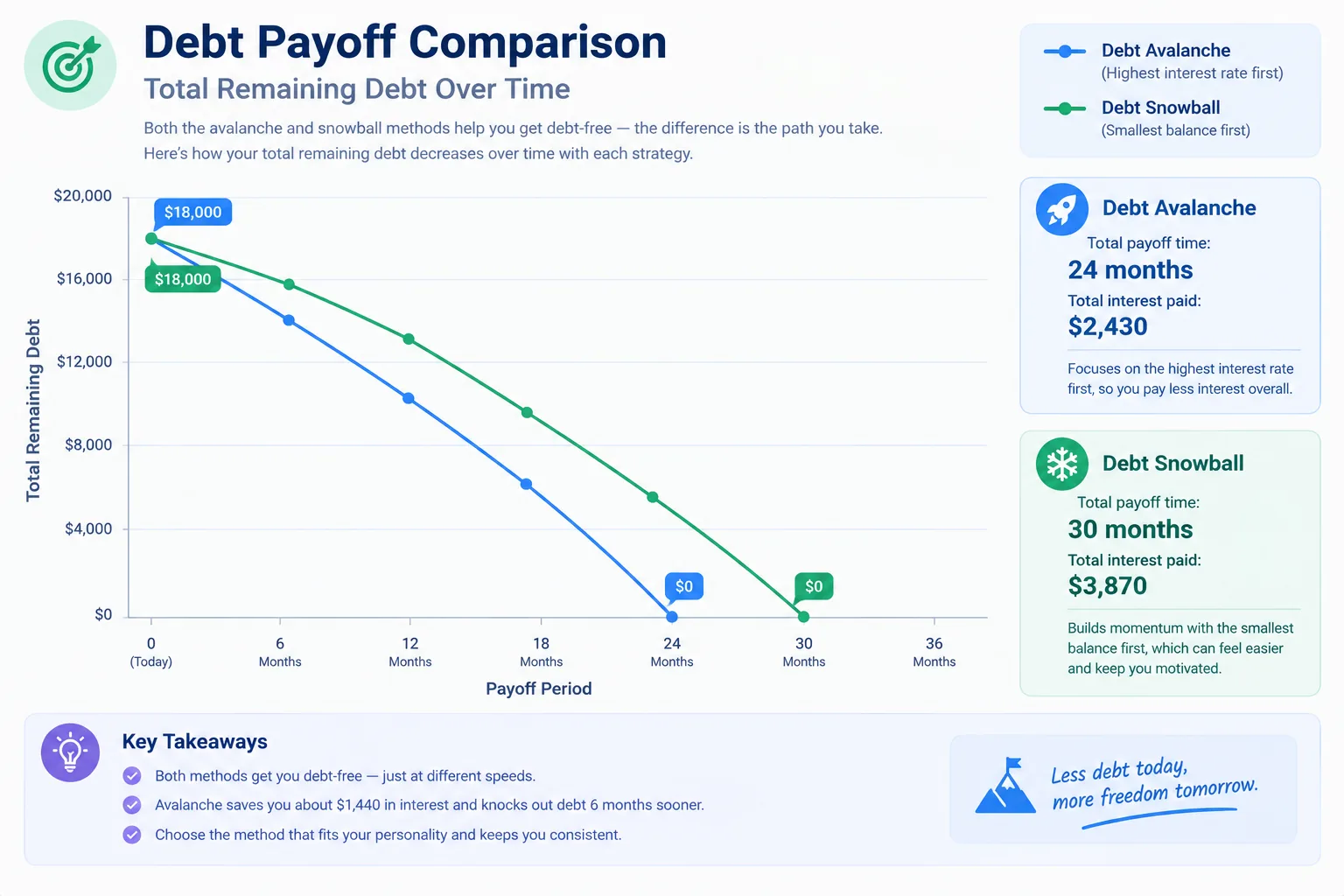
Avalanche puts every spare dollar toward the highest interest rate first, with minimums covering the rest. It’s the mathematically cheaper route over time — less total interest paid, period.
Snowball targets the smallest balance first, regardless of rate. You’ll typically pay somewhat more interest overall, but clearing individual debts faster keeps a lot of people motivated in a way the math alone doesn’t capture.
Prompt — Compare methods:
“Here are my debts: [paste your table]. My extra monthly budget beyond minimums is $[amount]. Compare the avalanche and snowball methods for my situation — show me the total interest paid and the payoff timeline for each, then tell me which one clears my debt faster and which saves more money.”
Step 3 — Model Your Payoff Timeline
Once you’ve picked a strategy, ask for the month-by-month picture. An actual debt-free date tends to motivate people more than the vague goal ever did — it’s the difference between “get out of debt” and a real countdown you can watch move.
Prompt — Build the timeline:
“Using the [avalanche/snowball] method and my numbers above, build a month-by-month payoff schedule. Show me the order debts get paid off, my projected debt-free date, and the total interest I’ll pay.”
Step 4 — Build a Monthly Check-In
A plan is only as good as how often you actually look at it again. Set a recurring prompt for the same day every month.
Prompt — Monthly check-in:
“Here’s my current balance on each debt as of this month: [list]. Compare it to the plan we built and tell me if I’m on track for my projected debt-free date, or what’s changed.”
If the “extra” payment amount is more theoretical than real right now, it’s worth working backward from a full budget first. Our guide on how to use ChatGPT for budgeting walks through building that starting point.
When to Get Human Help
There’s a point where this becomes more than a math problem. Consider talking to a certified, nonprofit credit counselor if you’re behind on payments or hearing from collections, if you’re weighing debt settlement or bankruptcy, or if the numbers above feel overwhelming instead of clarifying.
The National Foundation for Credit Counseling (NFCC) offers free or low-cost sessions with certified counselors, and the Consumer Financial Protection Bureau lays out your rights around debt collection in plain language.
Frequently Asked Questions
Can AI make a debt payoff plan? It can, once you give it your balances, rates, and minimum payments — from there it can compare strategies and build a month-by-month timeline. Accessing your accounts or making payments is outside what it does.
Is snowball or avalanche better? Avalanche saves more in total interest because it goes after the highest rate first. Snowball tends to hold people’s motivation longer because small balances disappear quickly. Neither is the “wrong” choice — it comes down to what actually keeps you consistent.
Is it safe to give AI my debt details? Balances, rates, and minimum payments, yes. Account numbers, card numbers, and your Social Security number, never.
When should I talk to a debt counselor? If you’re behind on payments, facing collections, or considering bankruptcy or settlement, a certified nonprofit counselor — the kind listed through the NFCC — can offer guidance an AI tool simply isn’t built to give.
Bottom Line
A paid app isn’t required to get a real debt-payoff plan. Ten minutes gathering your balances and rates, fed into a free AI chat tool, gets you an honest comparison of avalanche versus snowball and an actual debt-free date to work toward, and revisiting that plan monthly is what keeps it accurate as your numbers change.
Start today: pull up your statements, list your balances and rates in the Step 1 table above, and paste them into the Step 2 prompt — that’s the whole first move. If what comes back feels more complicated than the math suggests, bring it to a nonprofit credit counselor through the NFCC instead of guessing alone.
Related Reading
- 11 Best AI Budgeting Apps to Save Money in 2026: apps with built-in debt planners.
- How to Use AI to Improve Your Credit Score (2026): paying down debt and your credit score.
- How to Use AI to Save Money: 9 Practical Ways (2026): free up extra cash for payments.
- AI in Personal Finance: The Complete 2026 US Guide: the full guide to AI in personal finance.
AI tool features and behavior can change over time — verify current capabilities against the specific tool you’re using before relying on it for a financial decision.
Was this article useful?
Thanks, that helps us decide what to write next.
Spotted a mistake? Report an error and we will fix it, with a dated correction note.
Disclaimer. This article is general information, not financial, tax, or investment advice. Figures describe specific cases at specific dates. Talk to a licensed professional before acting on anything here. Full disclaimer.